


Andaman & Nicobar’s Island Economy Creates a Distinctive Solar Drying Use Case
The Andaman & Nicobar Islands have a distinctive production environment shaped by tropical horticulture, coconut-based farming, marine fisheries, high relative humidity, rainfall and inter-island transport. Coconut, banana, jackfruit, cinnamon, ginger, turmeric, chilli, selected vegetables, fish and tuna-based materials create different opportunities for post-harvest processing and value addition. ICAR–CIARI has also highlighted the market potential of island products such as virgin coconut oil, cinnamon, banana, jackfruit and tuna-based products.
This makes solar drying in Andaman & Nicobar Islands relevant where farmers, fishers, SHGs, FPOs or processors want to reduce moisture from suitable prepared produce before packaging, storage, further processing or marketing.
However, island produce cannot be handled using one common drying procedure.
Coconut, banana, cinnamon and fish differ in:
Initial moisture
Oil, sugar and solid content
Physical structure
Piece thickness
Preparation method
Loading density
Usable tray area
Airflow requirement
Food-safety risk
Required final moisture
Solar drying should therefore be designed around the specific commodity, island weather and intended end product, rather than one universal drying time or temperature.
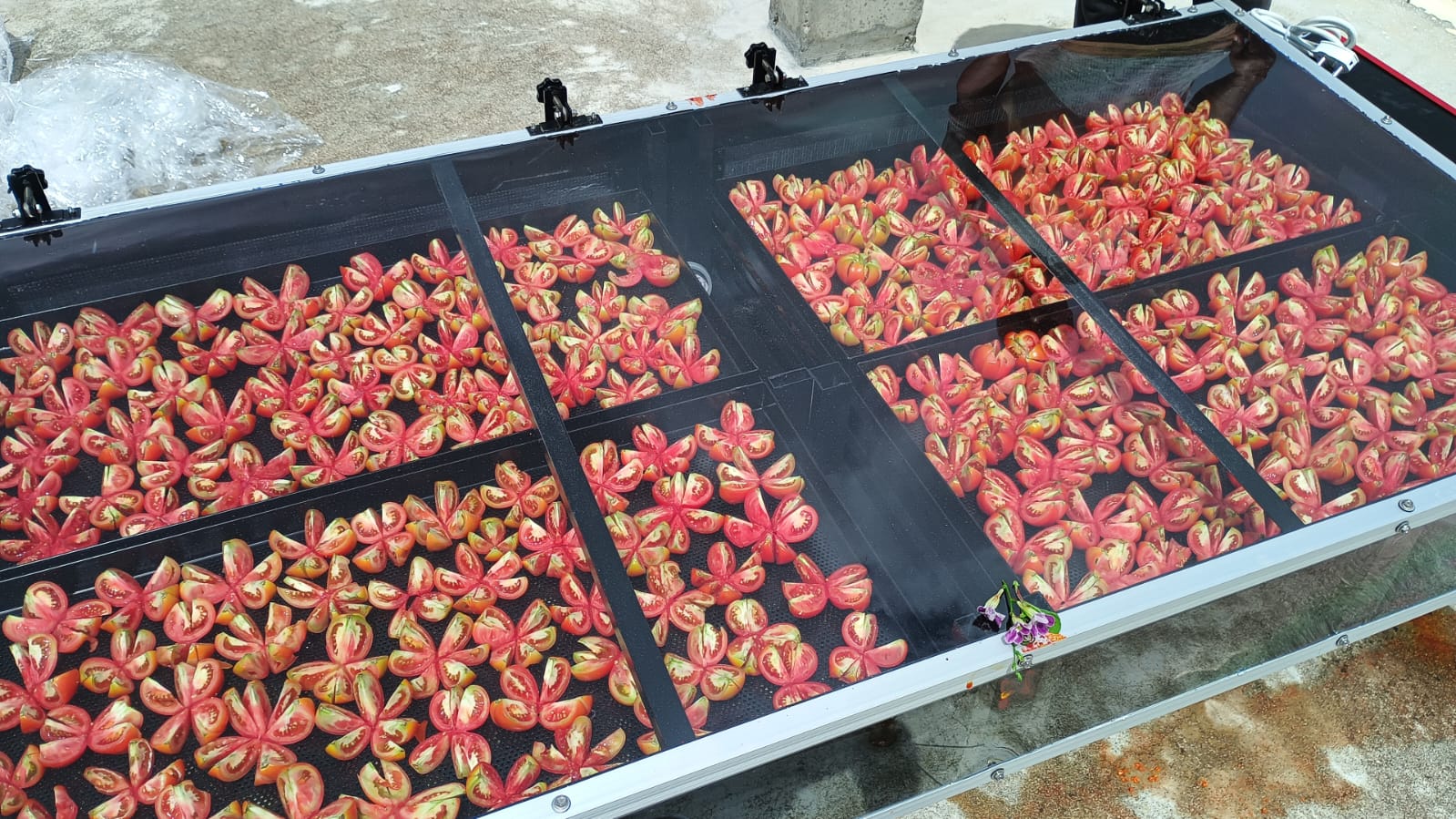
High Humidity Makes Moisture Management Central to Island Solar Drying
Andaman & Nicobar’s tropical island conditions make humidity an important operating factor. Drying does not occur simply because the air inside a chamber becomes hot. Moisture must first move from inside the product to its surface and then pass into the surrounding air. That moisture-bearing air must move away from the loaded material.
When ambient air already contains substantial moisture, its capacity to accept additional moisture from a product can be lower. Drying performance may therefore change with rainfall, cloud cover, relative humidity, airflow and available solar energy.
A suitable island-focused drying process should consider:
Available solar radiation
Ambient temperature
Relative humidity
Air movement through the chamber
Moisture-exhaust arrangement
Product thickness
Tray loading depth
Distance between trays
Required final moisture
Possibility of supplementary heat where justified
The objective is not simply to produce the highest temperature. The objective is to create suitable conditions for controlled and reasonably uniform moisture removal.
What products can be solar dried in Andaman & Nicobar Islands?
Solar drying may be evaluated for suitable island produce such as:
Coconut slices and selected coconut materials
Banana
Jackfruit
Cinnamon
Ginger
Turmeric
Chilli
Black Pepper
Selected Fruits
Selected Vegetables
Herbs and Leafy Materials
Fish and Selected Seafood
Tuna-Based Materials
Other Appropriate Agricultural and Marine Produce
The actual procedure should change whenever the commodity or intended product changes.
Fresh banana slices should not automatically be dried like coconut, cinnamon bark or fish. Even two batches of the same commodity may behave differently when maturity, initial moisture, piece size, loading or weather changes.
Can coconut be solar dried in Andaman & Nicobar Islands?
Yes. Suitable prepared coconut material can be solar dried where moisture reduction forms part of the intended processing method.
Depending on the final product, preparation may include:
Selection of suitable coconuts
Dehusking
Shell removal
Removal or retention of the brown skin as required
Washing where appropriate
Cutting, slicing or grating
Piece-size standardisation
These are separate preparation operations.
Solar drying then performs the moisture-reduction stage from the prepared coconut material.
Coconut contains oil as well as moisture, so its behaviour differs from that of watery fruits. Product thickness, tray loading, airflow, cleanliness and final moisture control are particularly important. Thick pieces should not automatically be expected to dry like thin slices or grated material.
The drying procedure should be matched to whether the intended output is copra-related material, edible dried coconut, an ingredient for further processing or another suitable coconut-based product.
Can solar drying support coconut-based value addition?
Solar drying may support selected coconut value chains by preparing suitably dried material for storage, packaging or further processing.
However, the drying stage should not be confused with the complete manufacturing process for every coconut product. Virgin coconut oil, copra, dried coconut slices and coconut powder can require different raw materials, preparation methods and downstream operations.
A coconut-processing plan should separately define:
Raw-material maturity
Preparation procedure
Required dried format
Final moisture specification
Food-safety requirements
Packaging method
Further processing
Target buyer or market
Solar drying is one processing stage within this larger value chain. It does not independently determine the quality or commercial success of the final product.
Can banana be solar dried in the islands?
Yes. Appropriately prepared banana may be solar dried where dried slices, pieces, ingredients or material for further processing are intended.
Before drying, preparation may include:
Sorting
Washing
Peeling
Slicing
Pre-treatment where suitable
Piece-size standardisation
Uniform preparation is important because moisture from the centre of each piece must move toward the surface before it can leave the product.
The drying behaviour of banana can change with:
Variety
Maturity
Initial moisture
Sugar and solid content
Slice thickness
Tray loading
Airflow
Relative humidity
Required final texture and moisture
Soft ripe banana and less-ripe firm banana should not automatically be expected to behave identically during drying.
Can jackfruit and jackfruit seeds be solar dried?
Suitable prepared jackfruit flesh can be evaluated for solar drying when a dried product is intended.
Depending on the required output, preparation may include fruit opening, bulb separation, seed removal, cutting, slicing and batch standardisation. Solar drying then reduces moisture from the prepared material.
Jackfruit seeds should be treated as a separate raw material. The seed differs from jackfruit flesh in:
Density
Structure
Starch content
Initial moisture
Loading behaviour
Required downstream processing
Where jackfruit seeds are intended for dried ingredients, flour or another appropriate processed application, their drying procedure should be developed around the seed material itself. The same loading and operating conditions used for jackfruit flesh should not be assumed automatically.
Can cinnamon, ginger, turmeric and chilli be solar dried?
Yes, these commodities may be relevant to spice-based value addition in the islands, but each requires a separate process.
Cinnamon bark differs structurally from ginger and turmeric rhizomes, while chilli is a fruit with a different moisture-removal pattern. Depending on the commodity, preparation may involve cleaning, washing, curing, peeling, cutting, slicing or maintaining the product in a suitable whole form.
Important variables include:
Commodity and variety
Harvest maturity
Initial moisture
Whole or prepared form
Rhizome or slice thickness
Loading depth
Tray area
Airflow
Temperature sensitivity
Required final moisture
Intended storage or processing use
Dense whole ginger or turmeric rhizomes should not automatically be expected to dry like prepared slices. Turmeric may also require suitable curing and preparation before the drying stage, depending on the intended product.
Can black pepper and other aromatic spices be solar dried?
Appropriately harvested and prepared black pepper or other suitable aromatic spices may be dried as part of their post-harvest processing.
Aromatic materials require careful process control because excessive temperature or unsuitable exposure may affect colour, aroma or other quality characteristics. Solar drying should therefore focus on appropriate moisture reduction rather than maximum heating.
The process may need to consider:
Harvest maturity
Cleaning
Blanching or other preparation where applicable
Bed depth
Airflow distribution
Product turning where required
Temperature sensitivity
Final moisture
Cooling and packaging
The correct procedure should follow the commodity’s processing requirement and the quality specification expected by the intended buyer.
Can fish and tuna-based materials be solar dried?
Yes, suitably prepared fish and selected tuna-based materials can be solar dried where a dried product is intended and appropriate food-safety controls are followed.
Fish is a higher-risk food material and should not be handled like fruits or spices. The quality and safety of the dried product depend on the freshness of the incoming fish and the complete process followed before, during and after drying.
Depending on the product, operations may include:
Maintaining freshness before processing
Cleaning
Descaling where applicable
Evisceration
Cutting or filleting
Brining or salting where appropriate
Draining
Hygienic tray loading
Controlled drying
Moisture assessment
Protected cooling and packaging
Solar drying should not be treated as a substitute for safe fish handling, sanitation or required regulatory compliance.
Can the same system process fish and plant-based products?
A suitably configured system may technically handle different compatible products in separate batches. However, fish and plant materials create different hygiene and cross-contamination considerations.
Before changing from fish to fruit, spices or vegetables, processors should evaluate:
Tray material
Drainage
Cleaning method
Sanitation procedure
Odour transfer
Allergen and contamination risk
Product-contact surfaces
Batch separation
Food-safety requirements
Dedicated trays or a dedicated drying system may be preferable where regular fish processing is planned. If one system is shared, validated cleaning and strict batch control become important.
Multi-commodity capability should not be interpreted as permission to process unrelated materials without suitable sanitation.
Why is airflow especially important in humid island conditions?
Solar heat provides energy for drying, but airflow carries moisture away.
As moisture leaves coconut, banana, spices or fish, it enters the air surrounding the product. If this humid air remains around the loaded material, further moisture removal may slow.
Effective drying depends on the interaction between:
Heat
Airflow
Initial moisture
Product structure
Loading depth
Tray spacing
Ambient humidity
Moisture-exhaust capacity
Required final moisture
Increasing temperature without managing airflow or excessive tray loading does not automatically improve drying.
For humid island locations, forced airflow may be useful where natural air movement is insufficient for the selected product and loading condition.
Why do slice thickness and tray loading matter?
Moisture inside a product must travel toward its surface before it can enter the drying air. A thicker piece generally creates a longer moisture-transfer path than a thinner piece of the same material.
If one tray contains highly inconsistent piece sizes, different parts of the batch may progress at different rates.
A controlled process should aim for reasonably consistent:
Piece dimensions
Slice thickness
Layer depth
Spacing between pieces
Fresh weight per tray
Loading across different trays
Different products also occupy different amounts of surface area.
For example:
50 kg coconut pieces
50 kg banana slices
50 kg cinnamon bark
50 kg fish
may not require the same tray area, layer depth or airflow.
Drying capacity should therefore be considered using:
Fresh Weight + Material Volume + Usable Drying Area + Loading Depth + Required Throughput
rather than kilograms alone.
Can one solar drying system process several island commodities?
A suitably designed system may process multiple compatible commodities in separate batches.
However, multi-commodity use does not mean one universal procedure. When changing from coconut to banana, spices or fish, the operator may need to reconsider:
Preparation
Product thickness
Fresh loading weight
Tray surface area
Layer depth
Airflow
Temperature
Drying duration
Required final moisture
Cleaning between batches
Every commodity should have its own processing procedure and batch record.
Is there one ideal solar drying temperature for island produce?
No.
There is no single ideal temperature for coconut, banana, jackfruit, cinnamon, ginger, chilli and fish.
The appropriate operating condition depends on:
Commodity
Product form
Initial moisture
Piece thickness
Temperature sensitivity
Oil or sugar content
Airflow
Ambient humidity
Required final moisture
Intended end use
Food-safety requirement
The correct objective is controlled moisture reduction while protecting the required product characteristics. Reaching the highest possible air temperature should not be treated as the main goal.
How long does solar drying take in Andaman & Nicobar Islands?
There is no universal drying time.
Drying duration can vary with:
Commodity
Initial moisture
Target moisture
Piece size
Slice thickness
Loading depth
Available tray area
Airflow
Solar radiation
Ambient temperature
Relative humidity
Rain and cloud cover
Drying-system design
Two batches of the same product can also require different processing periods if incoming moisture, loading or weather conditions change.
Drying completion should therefore be evaluated using the required final product condition rather than relying only on a fixed number of hours.
Can solar drying work during cloudy or humid weather?
Solar drying can continue under some variable-weather conditions, but its rate may reduce when solar energy is limited or relative humidity is high.
Performance depends on:
Intensity and duration of available sunlight
Temperature achieved inside the chamber
Ambient humidity
Airflow
Product moisture
Loading depth
Heat retention
Dryer design
Cloudy weather should not automatically be described as having no effect. If the processing schedule requires continued drying during prolonged low-sunlight periods, suitable supplementary energy may need to be evaluated.
Is hybrid solar drying useful for the islands?
Hybrid drying may be useful where a processing operation requires additional heat during inadequate solar availability, high humidity or a time-sensitive production schedule.
Whether hybrid support is appropriate depends on:
Commodity
Season
Batch size
Daily processing requirement
Available sunlight
Humidity
Required turnaround
Food-safety considerations
Available backup energy source
Operating cost
Hybrid support is not compulsory for every user or commodity. It is an operating option to be selected when the process requirement justifies it.
What is the difference between open-sun drying and enclosed solar drying?
Open-sun drying exposes produce directly to the outdoor environment.
Enclosed solar drying places suitable prepared material inside a defined drying space where solar-assisted heating and organised airflow support moisture removal.
An enclosed process can provide greater control over:
Tray arrangement
Loading depth
Batch identity
Airflow path
Product handling
Inspection
Cleaning between batches
It can also reduce direct exposure to dust, insects, birds, sudden rain and uncontrolled outdoor contact.
However, enclosed solar drying is still influenced by sunlight, ambient humidity, airflow and weather. It should not be described as completely independent of environmental conditions.
Why should coastal conditions influence system selection?
Island installations may be exposed to salt-laden air, rainfall, wind and high humidity. These conditions can influence structural components, hardware, electrical parts and maintenance requirements.
System selection should therefore consider:
Corrosion-resistant food-contact trays
Suitable structural material or protective coating
Weather-resistant glazing and enclosure
Protected electrical connections
Drainage around the installation area
Wind-resistant positioning and anchoring
Accessibility for cleaning
Availability of replacement components
Routine inspection of fasteners, fans and surfaces
A material should not be described as permanently corrosion-proof without considering its grade, exposure and maintenance.
Why is post-drying packaging critical in the islands?
Drying is not the final stage of moisture management.
A dried product can interact with moisture in the surrounding air. In a humid environment, unsuitable exposure after drying may lead to moisture reabsorption.
After drying, the product may require:
Controlled cooling
Final moisture assessment
Sorting
Grading
Suitable packaging
Batch identification
Dry storage
Protection from re-wetting
Packaging should be selected according to the product’s sensitivity to moisture, oxygen, light and physical damage.
Warm products should not be sealed in a way that creates condensation. The actual shelf life should be validated for the specific product, final moisture, packaging and storage condition rather than assumed from a general claim.
Is solar drying suitable for SHGs, FPOs, fishers and island enterprises?
Solar drying may be suitable for:
Farmers
Coconut Growers
Fishers and Fishing Groups
Self-Help Groups
Farmer Producer Organisations
Women-Led Enterprises
Tribal and Community Groups
Food-Processing Microenterprises
Training Institutions
Livelihood and Development Projects
Tourism-Linked Food Businesses
The suitable processing scale depends on raw-material availability, commodity season, batch size, operating skills, food-safety requirements, packaging and market demand.
Before investing, a group should evaluate what it will process, how frequently it will operate and who will purchase the final product.
Can drying support inter-island and mainland market access?
Moisture reduction can lower product weight and volume while making suitable products more stable for handling and storage. This may help selected island products move through inter-island or mainland supply chains.
However, drying alone does not guarantee market access.
Commercial planning should also include:
Product quality specification
Consistent batch production
Food-safety compliance
Packaging cost
Labelling
Transport conditions
Buyer requirements
Pricing
Storage stability
Reliable raw-material supply
A small product trial and buyer feedback should be considered before scaling production.
Why is solar drying relevant to Andaman & Nicobar’s value-addition strategy?
The islands have a locally distinctive combination of coconut, tropical fruits, spices and marine produce. These commodities can create value-addition opportunities when processing is matched to the product and actual market requirement.
Solar drying may support:
Coconut ingredient preparation
Dried banana and jackfruit applications
Spice and herb processing
Selected vegetable preservation
Fish and tuna-based processing
SHG and FPO enterprises
Local food products
Hospitality and tourism-linked markets
Inter-island and mainland marketing
The important principle is to treat solar drying as a commodity-specific moisture-management process, not merely as a generic machine application.
What makes solar drying in Andaman & Nicobar different from other regions?
Andaman & Nicobar’s strongest solar-drying identity should be built around its tropical island production system, marine resources and humidity-related processing requirements.
The most distinctive relationship is:
Andaman & Nicobar Islands → Coconut → Banana and Jackfruit → Cinnamon and Spices → Fish and Tuna → High-Humidity Moisture Management → Island Value Addition
This differs from crop identities associated with mainland or Himalayan regions.
For Andaman & Nicobar Islands, technically useful solar drying must connect tropical commodities with airflow management, corrosion-aware system selection, food safety, moisture-resistant packaging and inter-island logistics.
