


Solar Drying in Lakshadweep for Coconut, Copra, Tuna and Island Food Processing
Solar drying in Lakshadweep can support protected moisture removal for coconut, copra, tuna, traditional fish products, seaweed and suitable small-batch horticultural produce. However, the islands require a specialised drying strategy because persistent coastal humidity, salt-laden air, monsoon conditions and inter-island logistics can affect both drying performance and equipment durability.
Lakshadweep’s agriculture is strongly associated with coconut, while the Administration also promotes household and backyard cultivation of tomato, brinjal, chilli, sapota, mango and guava. The surrounding marine ecosystem supports a major tuna fishery, including the traditional dried tuna product known as masmin.
These commodities cannot follow one common drying procedure. Coconut kernel, tuna, seaweed, vegetables and fruit differ in moisture, fat, protein, hygiene risk, loading method and final product requirements. Solar drying becomes technically useful when each application is planned separately.
Why Is Solar Drying Important for Lakshadweep?
Lakshadweep consists of geographically separated islands located away from the mainland. Fresh agricultural and marine products may need to be processed, stored or transported according to vessel schedules, local infrastructure and market access.
Drying can reduce product moisture, weight and volume while creating more stable value-added products. It can also help island enterprises process suitable seasonal or surplus material rather than depending only on immediate fresh sale.
An enclosed solar drying process provides better physical protection than placing products directly in the open. It can reduce exposure to:
- Dust and wind-carried particles
- Birds, insects and animals
- Sudden coastal showers
- Direct ground or rooftop contact
- Uncontrolled handling
- Sea spray and salt-laden air
- Overnight moisture reabsorption
A solar dryer does not automatically guarantee safe food or long shelf life. Raw-material freshness, sanitation, airflow, temperature, final moisture, cooling, packaging and storage must all be controlled.
Which Products Can Be Solar Dried in Lakshadweep?
Potential applications include:
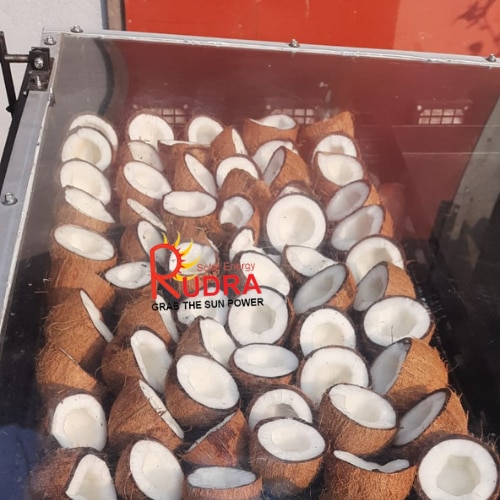
- Coconut kernel and prepared copra
- Coconut slices or chips
- Prepared coconut material for further processing
- Skipjack and yellowfin tuna
- Suitable traditional masmin-processing stages
- Other permitted and properly handled fish
- Seaweed produced for specified buyers
- Chilli and suitable spices
- Tomato and brinjal
- Mango, guava and sapota
- Culinary or medicinal leaves
- Suitable non-food coconut or plant materials
Product suitability depends on intended use and buyer specifications. Edible products, fish, seaweed and non-food materials should not be mixed in the same batch.
How Can Solar Drying Support Coconut and Copra Processing?
Coconut is central to Lakshadweep’s agricultural economy. The Administration’s Coconut Development Programme itself recognises the relevance of copra dryers to the islands.
After a coconut is opened, its kernel contains substantial moisture. If thick kernel pieces dry slowly or unevenly, moisture may remain in the interior even when the outer surface appears dry. This can contribute to mould growth, discolouration, undesirable odour or quality deterioration during storage.
A controlled process should address:
- Maturity and condition of the coconut
- Hygienic splitting and kernel removal
- Size and thickness of the pieces
- Tray material
- Loading depth
- Air movement around the kernel
- Product temperature
- Required final moisture
- Cooling and storage conditions
Pieces should be arranged to allow air movement rather than being piled in thick layers. The operator should verify the internal condition of representative pieces instead of relying only on surface appearance.
Copra intended for oil extraction may have different requirements from edible dried coconut intended for direct consumption. The drying schedule and hygiene system should be selected according to the final product.
Can Coconut Slices and Chips Be Solar Dried?
Yes, suitably prepared coconut can be dried as slices, chips, grated material or ingredients for further processing. Each form requires a different tray-loading procedure.
Thin coconut slices generally lose moisture differently from thick copra pieces. Grated coconut provides greater surface area but may create a dense layer if overloaded. It can also stick to unsuitable trays or become contaminated during handling.
For edible coconut products:
- Use sound and mature raw material.
- Follow hygienic shelling and kernel removal.
- Wash or prepare the kernel according to the validated process.
- Cut or grate it uniformly.
- Load a controlled layer on clean food-contact trays.
- Monitor airflow and product temperature.
- Verify the required drying endpoint.
- Cool the product under protected conditions.
- Pack it promptly in an appropriate moisture barrier.
High-fat coconut products also require protection from oxygen, excessive heat and unsuitable storage conditions. Drying alone cannot prevent rancidity when packaging and storage are poorly managed.
Can Coconut Husk or Coir Material Use the Same Dryer?
Food and non-food coconut applications should remain separate.
Coconut husk, coir, fibre or other non-food material may require moisture removal before storage or further processing. However, loose fibres, dust and residue can contaminate edible coconut products.
A facility handling both applications should use separate chambers where practical. At minimum, it requires dedicated trays, complete batch separation and a documented cleaning and inspection procedure before food processing resumes.
Can Tuna Be Solar Dried in Lakshadweep?
Tuna can be processed using solar-assisted drying only within a properly designed and hygienically controlled fish-processing system. Fish is a high-risk perishable raw material, so freshness and handling before drying are as important as the drying chamber itself.
The official Lakshadweep fisheries profile identifies tuna as the islands’ primary fishery resource and records dried products as an important use of local landings.
A safe tuna-processing plan should consider:
- Freshness at landing
- Immediate icing or temperature control
- Clean transport to the processing site
- Potable water and hygienic food-contact surfaces
- Cutting, cleaning and portion size
- Cooking, salting, brining or smoking where required
- Product thickness
- Airflow across every piece
- Protection from insects and dust
- Final moisture or water activity
- Cooling and packaging
- Storage and transport conditions
Solar drying should not be treated as a method for rescuing fish that has already deteriorated. Off-odour, decomposition, contamination or temperature abuse cannot be corrected by removing moisture.
What Is Masmin and How Can Protected Drying Support It?
Masmin is a traditional dried tuna product associated with Lakshadweep. Its production includes preparation stages beyond simple exposure to sunshine.
Depending on the established process, fish may undergo cleaning, cutting, cooking, smoking and drying. A protected solar drying stage may support more controlled moisture removal, but it should not be presented as a replacement for required cooking, smoking or other traditional processing steps.
For masmin, the drying system should preserve the required product identity while improving protection from environmental contamination. The operator must establish:
- Correct preparation before drying
- Suitable piece dimensions
- Required smoke treatment where applicable
- Safe loading conditions
- Final moisture or water-activity target
- Expected colour, texture and flavour
- Cooling and packaging method
- Applicable food-safety and buyer requirements
Traditional knowledge should be combined with measurable process controls rather than replaced by a generic drying schedule.
Should Fish and Coconut Be Dried in the Same Chamber?
Fish and plant-based products should preferably use dedicated drying arrangements.
Fish can leave odour, oil, protein residue and allergen contamination on trays and internal surfaces. Coconut, fruit, vegetables or herbs processed afterward may absorb odour or come into contact with fish residue.
Where one chamber must serve multiple applications, the facility requires:
- Completely separate batches
- Dedicated fish and plant-product trays
- Separate knives, cutting boards and preparation tools
- Removal of all visible residue
- Validated cleaning and sanitation
- Drying and inspection before reuse
- Allergen-control procedures
- Clear batch records
Fish and coconut must never be loaded together merely because they require processing on the same day.
Can Seaweed Be Solar Dried in Lakshadweep?
Seaweed is an emerging livelihood and processing opportunity in Lakshadweep. The Fisheries Department records community-led seaweed demonstration activity involving self-help groups across inhabited islands.
Solar drying may support seaweed processing when the species, intended use and buyer specification are already defined. Food, feed, agricultural-input and industrial seaweed markets may require different purity, colour, moisture and contamination limits.
A seaweed-drying procedure should address:
- Correct species identification
- Harvesting permission and sustainability
- Removal of sand and foreign material
- Washing method required by the buyer
- Removal of excess surface water
- Uniform layer thickness
- Protection from ground contact
- Controlled airflow
- Salt and moisture specifications
- Final sorting and packaging
Seaweed should not be dried in the same batch as fish or edible coconut. Dedicated trays and product-specific cleaning are necessary.
How Does Island Humidity Affect Solar Drying?
Lakshadweep’s coastal climate can remain humid for much of the year. Official island information for Andrott, for example, records humidity around 70–76% for much of the year and a substantial monsoon period.
High humidity slows drying because the incoming air already carries considerable moisture. The chamber may feel hot while the air has limited capacity to absorb more water from the product.
During humid conditions, processors may need to:
- Reduce the quantity loaded per tray
- Use thinner and more uniform pieces
- Increase spacing between pieces
- Maintain unobstructed air inlets and exhaust
- Use adequate forced airflow
- Monitor products on different trays
- Prevent partly dried products from remaining exposed overnight
- Check for moisture reabsorption before packaging
- Consider hybrid assistance for time-sensitive batches
Maximum chamber temperature is not the only performance measure. Useful drying depends on the relationship between heat, humidity, airflow and the product’s internal moisture movement.
Can Solar Drying Continue During the Monsoon?
Solar-only drying becomes slower and less predictable during prolonged cloud, rain or high humidity. A solar-only system may still suit users who can adjust loading and production schedules according to the weather.
Hybrid assistance may be considered where:
- Fish must be processed without unsafe delays
- Regular commercial production is required
- Coconut or seaweed batches cannot remain partly dried
- Cloudy weather continues for an extended period
- Final-stage moisture removal becomes difficult
- The enterprise has committed delivery schedules
The hybrid heat source and controls must be compatible with the commodity. Hybrid operation should not expose fish, coconut, herbs or other sensitive products to uncontrolled high temperature.
How Long Does Solar Drying Take in Lakshadweep?
There is no universal drying time for copra, tuna, seaweed, fruit or vegetables.
Drying duration changes with:
- Commodity and variety
- Initial moisture
- Required final moisture
- Piece size and thickness
- Preparation method
- Tray-loading density
- Chamber airflow
- Product temperature
- Ambient humidity
- Solar radiation
- Rain and cloud cover
- Solar-only or hybrid operation
A drying period reported for one island, season or batch should not automatically be applied to another. Initial trials and batch documentation are essential.
How Should Drying Capacity Be Selected for an Island Project?
Capacity should be based on reliable raw-material availability and realistic operating frequency—not only the largest quantity available during peak season.
Before selecting capacity, determine:
- Primary commodity
- Fresh kilograms available per batch
- Number of operating days
- Peak and off-season availability
- Required tray area
- Preparation and loading method
- Solar-only or hybrid requirement
- Available water and sanitation facilities
- Cooling and packaging space
- Electrical or backup-energy availability
- Inter-island transport requirements
- Confirmed buyer or market channel
Coconut pieces, tuna and seaweed can occupy very different tray areas at the same fresh weight. Capacity must therefore be evaluated using both weight and loading density.
A modular approach may be useful where raw-material supply varies across islands or where fish and coconut require separate processing.
Why Does Corrosion Resistance Matter in Lakshadweep?
Salt-laden coastal air can accelerate corrosion of unsuitable metals, fasteners, electrical connections and external components.
A drying system intended for Lakshadweep should be evaluated for:
- Corrosion-resistant exposed components
- Suitable tray and fastener materials
- Protection of fans and electrical connections
- Drainage and wash-down requirements
- Ease of cleaning
- Availability of replacement components
- Periodic inspection and maintenance
- Wind and site-exposure conditions
Even corrosion-resistant materials require cleaning and inspection. Salt deposits should not be allowed to accumulate on airflow components, trays or external surfaces.
Cooling, Packaging and Transport After Drying
Drying is incomplete until the product is cooled and packed correctly.
Warm dried material should not be sealed immediately because trapped heat may create condensation inside the package. At the same time, leaving dried material exposed to humid island air can cause rapid moisture reabsorption.
A suitable sequence is:
- Confirm the required drying endpoint.
- Remove the product under hygienic conditions.
- Cool it in a clean, protected and low-humidity area.
- Avoid prolonged exposure to ambient air.
- Pack it using an appropriate moisture barrier.
- Seal and label the batch.
- Store it away from heat, water and contamination.
- Monitor the product before inter-island or mainland transport.
Fish, coconut, seaweed and horticultural products require different packaging specifications. The buyer’s requirements should be confirmed before commercial production begins.
Who Can Use Solar Drying in Lakshadweep?
Potential users include:
- Coconut growers and copra processors
- Fishing communities
- Tuna and masmin-processing groups
- Women’s self-help groups
- Seaweed producer groups
- Island cooperatives
- Household and backyard horticulture growers
- Food-processing micro-enterprises
- Livelihood and training institutions
- Organisations developing island value chains
Every enterprise should begin with one clearly defined product, conduct controlled trials and confirm market acceptance before investing in large-scale production.
Planning Solar Drying for Lakshadweep
A technically suitable project should begin with the commodity—not the machine size.
The assessment should document:
- Raw material and its condition
- Fresh quantity per batch
- Preparation method
- Intended final product
- Food or non-food use
- Required final moisture or water activity
- Local humidity and monsoon conditions
- Need for solar-only or hybrid operation
- Hygiene and allergen controls
- Packaging and storage
- Inter-island or mainland transport
- Buyer specifications
For Lakshadweep, the most important approach is:
Coconut → Copra and Food-Grade Coconut Products
Tuna → Masmin and Suitable Dried Fish Products
Seaweed → Buyer-Specific Food, Feed or Industrial Material
Backyard Produce → Small-Batch Fruit, Vegetable and Chilli Processing
Each category must have its own preparation, tray loading, airflow, temperature, hygiene and packaging procedure.
Solar drying becomes valuable when it is treated as a controlled island-processing system—not simply as exposure to strong tropical sunshine.
