


Solar Drying Connects Inland Horticulture with Coastal Food Processing
The Union Territory of Dadra & Nagar Haveli and Daman & Diu presents two different post-harvest environments within one administrative region. Dadra & Nagar Haveli has an inland agricultural and horticultural context, while Daman and Diu have strong coastal characteristics and an established fisheries framework. Chikoo, mango, selected fruits, vegetables, herbs, spices, fish and other suitable produce can therefore create different solar drying applications across the Union Territory.
The official Agriculture Department has repeatedly issued notices related to the sale of chikoo fruits, confirming chikoo as a locally relevant horticultural commodity. The Union Territory also has a dedicated Fisheries Department and marine fishing regulations, establishing a clear coastal and fisheries context for Daman and Diu.
However, fruit and fish cannot be processed using one common drying procedure.
Every commodity differs in:
- Initial moisture
- Physical structure
- Sugar, fibre, oil or protein content
- Product thickness
- Preparation requirements
- Loading density
- Airflow requirements
- Temperature sensitivity
- Required final moisture
- Food-safety considerations
- Intended final product
Solar drying in Dadra & Nagar Haveli and Daman & Diu should therefore be planned as a commodity-specific moisture-management process rather than as a single universal drying method.
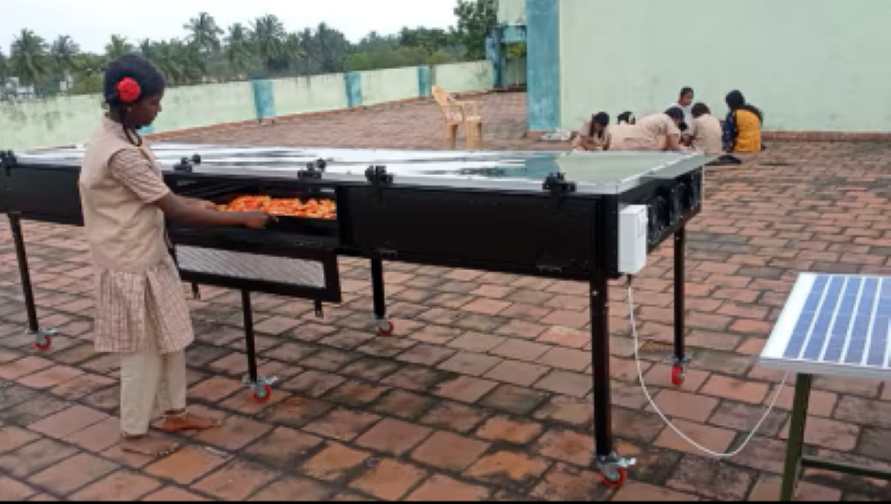
Why is solar drying relevant to Dadra & Nagar Haveli and Daman & Diu?
Solar drying can support suitable post-harvest and food-processing activities where moisture reduction is required before packaging, storage, grinding or further value addition.
Potential applications differ across the Union Territory.
In Dadra & Nagar Haveli, solar drying may be relevant for suitable horticultural produce, vegetables, herbs and other agricultural materials.
In Daman and Diu, applications may include suitable fruits, coastal produce and properly prepared fish where drying forms part of the intended processing method.
The main objective is not simply to expose food to heat. A technically useful drying process must coordinate:
- Solar energy
- Air movement
- Product preparation
- Tray surface
- Loading depth
- Moisture removal
- Hygiene
- Required final condition
What commodities can be solar dried in this Union Territory?
Depending on availability, processing requirements and intended use, solar drying may be evaluated for:
- Chikoo or sapota
- Mango
- Banana
- Selected vegetables
- Herbs
- Spices
- Chillies
- Coconut products
- Suitable marine fish
- Other appropriate horticultural and coastal produce
This list does not mean that all commodities should use identical drying conditions.
A sliced fruit, leafy herb, whole chilli and prepared fish batch behave very differently during moisture removal. Each product requires an individual drying procedure.
Can chikoo be solar dried?
Yes. Properly selected and prepared chikoo, also written as chickoo and commonly known as sapota, can be evaluated for solar drying where a dried fruit product, ingredient or powder-making application is intended.
The Agriculture Department’s repeated notices concerning chikoo fruit make it an especially relevant local application for this Union Territory.
Depending on the intended product, preparation may include:
- Sorting
- Washing
- Peeling where required
- Removal of seeds
- Cutting or slicing
- Piece-size standardisation
- Uniform tray loading
Chikoo contains natural sugars and considerable moisture. Its ripeness, slice thickness and loading depth can influence the way a batch dries.
Very soft, overripe fruit should not automatically be processed in the same way as firm, properly mature fruit. Incoming material should first be inspected and separated according to condition.
Why is chikoo slice thickness important?
Moisture inside a chikoo slice must move toward its surface before it can enter the surrounding drying air.
Thicker pieces generally create a longer path for internal moisture movement than thinner slices. If one tray contains highly inconsistent piece sizes, individual pieces may reach different drying stages at different times.
A chikoo drying process should therefore aim for reasonable consistency in:
- Fruit maturity
- Slice thickness
- Piece dimensions
- Tray loading
- Layer depth
This does not mean one exact slice thickness is correct for every chikoo product. The preparation method should be selected according to the required dried format and final use.
Can mango be processed through solar drying?
Yes. Appropriately prepared mango can be solar dried where products such as dried slices, pieces, ingredients or other dehydrated formats are intended.
Preparation may include:
- Selection by maturity
- Washing
- Peeling
- Removal of the stone
- Slicing or cutting
- Piece-size standardisation
- Suitable pre-treatment where required by the process
Different mango varieties and maturity stages may contain different levels of moisture, fibre and soluble solids. These differences can affect drying behaviour.
A processor should not assume that every mango batch will require the same drying duration simply because its fresh weight is identical.
Can banana and other fruits be solar dried?
Suitable banana and other locally available or procured fruits may be evaluated for solar drying after appropriate preparation.
Banana drying can be influenced by:
- Variety
- Ripeness
- Slice thickness
- Initial moisture
- Product stickiness
- Tray surface
- Loading density
- Airflow
- Required final moisture
The same principles apply to other fruits, but the actual procedure must change with the commodity.
Fruits with different sugar levels, structures and initial moisture should not automatically be dried together in one mixed batch.
Can marine fish be solar dried in Daman and Diu?
Yes, properly handled fish can be evaluated for controlled solar drying where dried fish is the intended product and applicable food-safety requirements are followed.
Daman and Diu have an established marine-fishing context supported by the Union Territory’s Fisheries Department and marine fishing regulations.
Fish preparation may involve:
- Selection of fresh raw material
- Hygienic washing
- Cleaning
- Gutting where required
- Cutting or splitting
- Salting or another approved treatment where applicable
- Draining
- Organised tray loading
These preparation stages are separate from solar drying.
Solar drying performs the moisture-reduction stage. It does not replace hygienic handling, sanitation, appropriate raw-material control, safe processing practices or suitable storage.
Can fruits and fish be dried in the same batch?
No. Fruits and fish should not be treated as compatible materials for simultaneous drying.
They differ in:
- Raw-material characteristics
- Odour
- Microbiological risk
- Preparation procedure
- Food-safety requirements
- Cleaning requirements
- Required final condition
Where one drying system is intended for both categories, they should be processed in completely separate batches.
Thorough cleaning, sanitation and inspection should be completed before changing from fish to fruits, vegetables, herbs or spices. Depending on the business and food-safety plan, dedicated trays or separate processing arrangements may be more appropriate.
Can vegetables, herbs and spices also be solar dried?
Yes. Suitable vegetables, herbs, chillies and spices may be processed through solar drying when dehydration is appropriate for the intended product.
Preparation can include:
- Sorting
- Cleaning
- Washing where applicable
- Peeling
- Cutting
- Slicing
- Blanching or another required pre-treatment
- Draining
- Uniform tray loading
Leafy herbs generally have a different structure and loading behaviour from dense vegetables or whole spices.
A shallow herb layer may occupy substantial tray space despite having a relatively low fresh weight. Dense vegetable pieces may occupy less visible space but contain more internal moisture.
Capacity should therefore not be evaluated through kilograms alone.
How does coastal humidity influence solar drying?
Humidity is an important operating factor in coastal locations such as Daman and Diu.
Drying air must receive moisture from the product and carry it away. When the surrounding air already contains substantial moisture, the rate at which additional moisture can be removed may change.
Coastal drying performance can be affected by:
- Relative humidity
- Available solar radiation
- Ambient temperature
- Cloud cover
- Airflow
- Product thickness
- Loading depth
- Initial moisture
- Required final moisture
This does not mean solar drying is unsuitable in coastal areas. It means the system must be operated according to actual environmental and product conditions rather than assuming identical performance every day.
Why is airflow as important as solar heat?
Solar heat provides energy for moisture removal, but heat alone does not complete the drying process.
As moisture leaves the commodity, it enters the air surrounding the product. This moisture-bearing air must move away so additional moisture can continue leaving the material.
Effective drying therefore depends on the interaction between:
- Heat
- Airflow
- Product structure
- Tray spacing
- Loading depth
- Air humidity
- Moisture-removal requirement
Simply increasing temperature without managing airflow or excessive loading does not automatically produce better drying.
Why does tray loading vary between chikoo, mango and fish?
The same fresh weight of different commodities may require very different amounts of drying surface.
For example:
- 50 kg of sliced chikoo
- 50 kg of mango slices
- 50 kg of whole chillies
- 50 kg of prepared fish
may not occupy the same tray area or form the same loading depth.
Their exposed surface area, density, piece dimensions and airflow pathways can be completely different.
Drying capacity should therefore be evaluated using:
Fresh Weight + Material Volume + Usable Tray Area + Loading Depth + Required Throughput
Kilogram capacity alone does not fully describe how much material can be processed effectively in one batch.
Can one solar drying system process multiple commodities?
A suitably configured system may process several compatible commodities in separate batches.
However, multi-commodity capability does not mean one fixed process setting can be used for every product.
Whenever the commodity changes, the operator may need to reconsider:
- Preparation method
- Piece dimensions
- Tray arrangement
- Loading depth
- Airflow
- Temperature
- Drying duration
- Required final moisture
- Cleaning requirements
A separate operating procedure should be developed for each major commodity.
Fish should receive particularly careful separation because of hygiene, odour and cross-contamination considerations.
Is there one ideal temperature for solar drying in this region?
No. There is no single ideal temperature for chikoo, mango, banana, vegetables, herbs, spices and fish.
The appropriate drying condition depends on:
- Commodity
- Product form
- Initial moisture
- Piece thickness
- Temperature sensitivity
- Airflow
- Ambient humidity
- Required final moisture
- Intended final use
The objective should be controlled moisture reduction while maintaining the required product characteristics—not simply reaching the highest possible air temperature.
How long does solar drying take?
There is no universal solar drying time.
Drying duration can change according to:
- Commodity
- Initial moisture
- Target moisture
- Fruit maturity
- Piece or slice thickness
- Tray loading
- Airflow
- Available sunlight
- Ambient humidity
- System configuration
- Weather conditions
Two batches of the same commodity may also behave differently when incoming moisture, maturity or weather changes.
The drying endpoint should therefore be assessed through the required final condition and an appropriate moisture-measurement method rather than relying only on a fixed number of hours.
Is hybrid solar drying useful in coastal conditions?
Hybrid support may be useful where a processing operation requires greater continuity during periods of insufficient solar availability or high humidity.
Whether hybrid assistance is appropriate depends on:
- Commodity
- Season
- Processing schedule
- Daily throughput
- Available solar energy
- Required turnaround
- Backup energy availability
- Quality and food-safety plan
Hybrid drying is not compulsory for every application. It is an operating option that should be evaluated according to the actual processing requirement.
What is the difference between open-sun drying and enclosed solar drying?
Open-sun drying places the commodity directly in the outdoor environment.
Enclosed solar drying places suitably prepared material inside a defined drying space where solar-assisted heating and organised airflow can support moisture removal.
An enclosed process can provide greater control over:
- Tray arrangement
- Loading depth
- Batch separation
- Air movement
- Product handling
- Inspection
- Cleaning between batches
It can also reduce direct exposure to dust, insects, birds and uncontrolled outdoor contact.
However, enclosed solar drying should not be presented as completely independent of weather. Available sunlight, ambient humidity and environmental conditions can still influence performance.
What preparation is required before solar drying?
Drying should not begin before the raw material has been properly prepared.
The exact preparation depends on the product, but it may include:
- Raw-material inspection
- Sorting
- Washing
- Peeling
- Cutting or slicing
- Seed, stone or core removal
- Gutting or splitting of fish
- Suitable pre-treatment
- Draining
- Batch identification
- Uniform tray loading
Preparation influences exposed surface area, loading consistency and moisture movement.
A well-designed dryer cannot compensate for unsuitable raw material, highly inconsistent piece sizes or poor hygiene.
Why is post-drying handling important?
Moisture management does not end when material leaves the drying chamber.
After drying, suitable products may require:
- Controlled cooling
- Moisture assessment
- Sorting
- Grading
- Packaging
- Labelling
- Storage
- Protection from re-wetting
This is particularly important in humid or coastal environments.
If dried material is left exposed to unsuitable conditions, it may interact with moisture in the surrounding air. Packaging and storage should therefore be planned together with the drying process.
How should processing capacity be selected?
Capacity should be selected according to the actual production requirement rather than only the maximum harvest available on one day.
A practical assessment should consider:
- Commodity
- Fresh quantity per batch
- Material volume
- Seasonal availability
- Preparation method
- Usable tray area
- Desired loading depth
- Daily throughput
- Available drying window
- Required final moisture
- Solar-only or hybrid operation
- Planned product range
Processors expecting to handle both fruits and fish should also consider cleaning time, batch separation, dedicated trays and food-safety requirements.
Who can explore solar drying in the Union Territory?
Solar drying may be relevant to suitable applications involving:
- Farmers
- Horticulture growers
- Fisher groups
- Fish processors
- Farmer collectives
- Self-help groups
- Micro-enterprises
- Food-processing businesses
- Institutions
- Hospitality-linked processors
- Value-addition centres
The correct configuration depends on the commodity, scale, hygiene requirements and intended market.
No system should be selected only because another user processes the same fresh weight. Product characteristics and operating objectives must also be evaluated.
What makes solar drying in Dadra & Nagar Haveli and Daman & Diu distinctive?
The Union Territory should not be represented through one generic crop or one uniform post-harvest condition.
Its strongest solar drying identity connects:
Dadra & Nagar Haveli → Inland Horticulture → Chikoo and Suitable Farm Produce
with:
Daman & Diu → Coastal Conditions → Fish and Suitable Coastal Produce
This creates a distinctive combination of:
- Fruit processing
- Horticultural value addition
- Coastal food processing
- Fish moisture management
- Humidity-aware drying
- Separate hygiene procedures
- Multi-commodity batch planning
The most important principle is that chikoo, mango, vegetables, herbs, spices and fish must each receive their own preparation, loading, airflow and drying procedure.
Solar drying becomes technically useful when it is treated as a controlled, commodity-specific post-harvest process—not merely as exposure to solar heat.
