


Solar Drying in Puducherry for Coconut, Banana, Tapioca, Chilli & Coastal Produce
Puducherry has a distinctive food-processing environment because the Union Territory is spread across four geographically separated regions—Puducherry, Karaikal, Mahe and Yanam—with strong agricultural as well as coastal-fisheries activity. Crops recorded in the Union Territory include rice, tapioca, chilli, groundnut, gingelly and coconut, while banana and mango are also relevant horticultural produce.
This diversity creates several opportunities for solar drying, but Puducherry’s warm, humid and monsoon-influenced climate also means that successful drying requires much more than simply exposing produce to heat.
Solar drying can support farmers, SHGs, FPOs, fishing communities and food-processing entrepreneurs by providing a more enclosed and organised method of moisture reduction for suitable agricultural and fishery products. The appropriate preparation, loading method, airflow and drying conditions must always be matched to the commodity being processed.
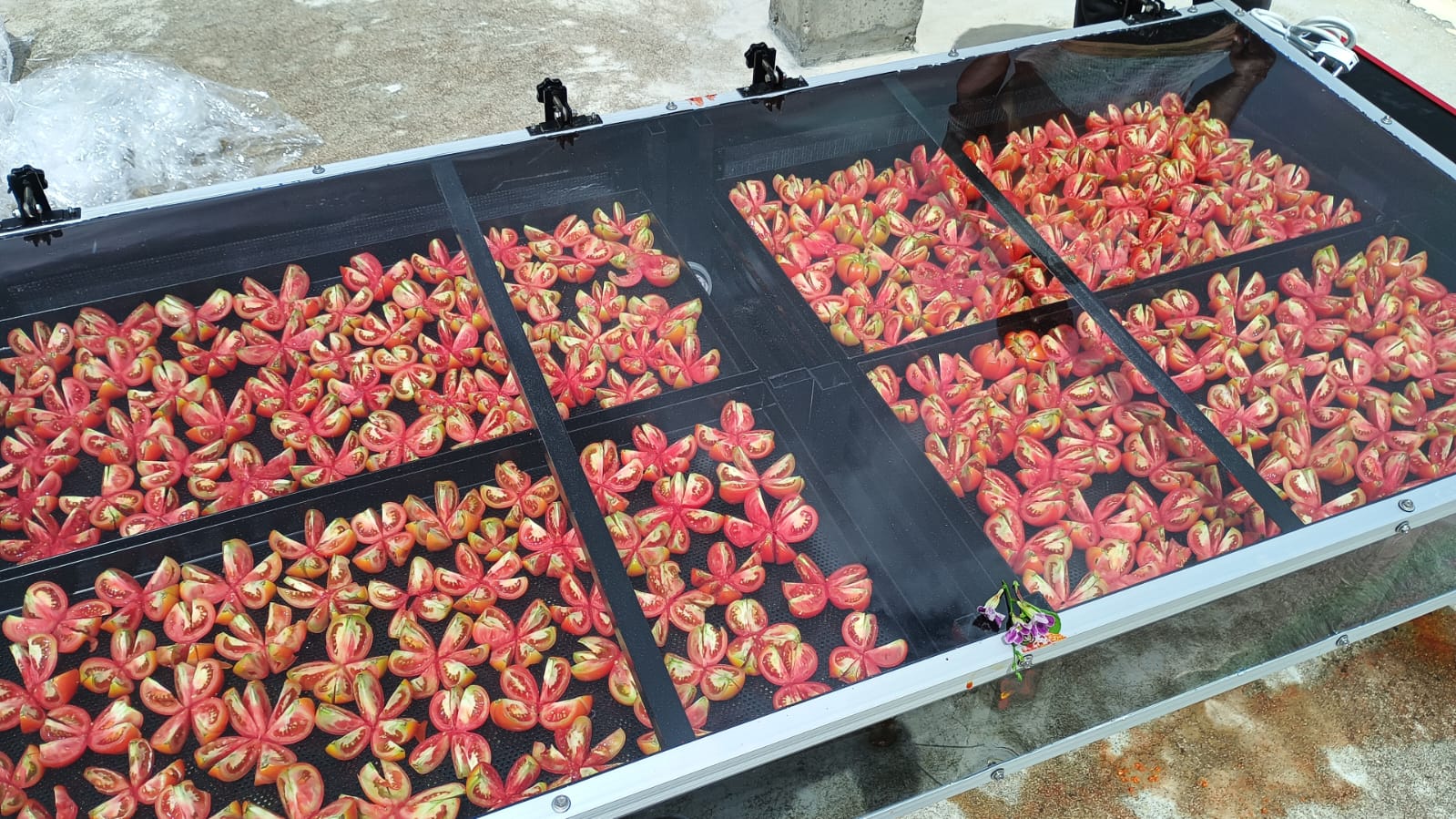
Solar Drying Applications Across Puducherry’s Coastal and Agricultural Economy
Coconut and Copra Processing
Coconut is an important crop within Puducherry’s agricultural system and creates one of the most relevant local solar-drying applications.
Depending on the intended product, coconut processing may involve moisture reduction for copra or other dried coconut products. The material should be properly prepared and loaded so that air can circulate effectively around the product.
For coconut-based drying, important factors include:
Initial moisture
Size and thickness of prepared material
Loading density
Air circulation
Drying temperature
Required final moisture
Post-drying storage
Drying should continue until the product reaches the condition required for its intended use rather than relying on a fixed number of hours.
Banana and Mango Value Addition
Banana and mango can provide opportunities for value-added fruit processing where suitable produce is available.
Fresh fruit contains substantial moisture, so preparation has a major influence on drying behaviour.
A typical fruit-processing sequence may include:
Sorting → washing → peeling where required → uniform slicing → suitable pretreatment where needed → tray loading → drying → cooling → packaging
Uniform slice thickness is particularly important because thick and thin pieces loaded in the same batch may lose moisture at different rates.
Solar drying can support products such as dried banana slices, mango slices and fruit ingredients for further processing, depending on product formulation and market requirements.
Tapioca Drying and Processing
Tapioca is another crop recorded in Puducherry’s agricultural production.
For suitable processed tapioca products, moisture reduction may form part of the value-addition or storage-preparation process.
Tapioca should not be treated exactly like fruit. Preparation method, piece size, starch characteristics, loading and final product requirement all influence the drying procedure.
Processors should establish a commodity-specific process instead of applying the temperature and drying duration used for banana, chilli or another product.
Chilli, Groundnut and Gingelly
Puducherry also produces chilli, groundnut and gingelly.
These products represent three very different drying situations.
Chilli contains relatively high moisture when harvested fresh and requires appropriate drying before stable handling or further processing.
Groundnut requires careful post-harvest moisture management according to whether pods, kernels or another processed form are being handled.
Gingelly and other seeds require attention to layer depth, initial moisture and airflow.
The fact that all three commodities can involve drying does not mean that one operating procedure should be used for all of them.
Vegetables and Small-Batch Food Processing
Selected vegetables and herbs can also be processed through solar drying where technically appropriate.
Depending on the product, preparation may include washing, peeling, slicing, blanching or another suitable pretreatment.
For SHGs and small food-processing businesses, solar drying can form part of a broader value-addition workflow involving:
Raw-material selection
Preparation
Hygienic handling
Controlled tray loading
Moisture reduction
Product cooling
Packaging
Storage
The drying system should therefore be considered one part of the complete processing chain rather than an isolated step.
Fish Drying in a Coastal Union Territory
Fisheries are particularly relevant to Puducherry because the Union Territory includes coastal fishing communities across its geographically separated regions.
Drying can be used for suitable fish products where the intended processing method, hygiene controls and food-safety requirements support it.
Fish requires a more carefully managed process than simply placing the catch under sunlight.
Important steps can include:
Selecting suitable fresh raw material
Cleaning and preparation
Appropriate salting or other processing where required
Controlled loading
Adequate airflow
Moisture reduction
Hygienic post-drying handling
Appropriate packaging and storage
An enclosed drying environment can offer better physical protection from dust and insects than direct open-ground exposure.
However, drying alone does not guarantee microbiological safety or a fixed shelf life. Raw-material quality, sanitation, final moisture, packaging and storage conditions remain critical.
Managing Solar Drying in Puducherry’s Humid and Monsoon-Influenced Conditions
Puducherry’s coastal setting makes ambient humidity an important part of the drying process.
Solar drying works by transferring moisture from the product into the surrounding air and carrying that moisture away through airflow. When the surrounding air is already humid, its ability to accept additional moisture can be reduced.
This means drying performance in Puducherry can vary substantially according to:
Solar radiation
Relative humidity
Ambient temperature
Rainfall and cloud cover
Season
Commodity
Initial moisture
Required final moisture
Slice or particle dimensions
Quantity loaded
Tray-loading density
Airflow
Dryer configuration
During humid or cloudy periods, processors should not assume that the same drying performance achieved on a clear, dry day will automatically be repeated.
Where consistent production during weak-sun or monsoon periods is important, the processing requirement may need an appropriately designed hybrid or backup approach.
Why Enclosed Solar Drying Can Be Useful
Traditional open-sun drying exposes the product directly to the surrounding outdoor environment.
An enclosed solar drying system can provide:
Better physical protection from dust and insects than direct open-sun exposure
Organised tray-based loading
More defined airflow around the product
A dedicated food-drying environment
Better process organisation for repeated batches
These advantages can support more structured processing, but they do not remove the need for correct food preparation, hygiene or moisture assessment.
There Is No Universal Solar Drying Time
No single drying time can accurately apply to coconut, banana, tapioca, chilli, groundnut, herbs and fish.
Even the same commodity can dry differently from one batch to another.
Actual drying performance depends on the interaction between the product and operating conditions.
For example:
A thin banana slice exposes more surface area than a thick piece.
Fresh chilli behaves differently from partially dried chilli.
Groundnut in pods behaves differently from kernels.
Fish thickness, preparation and salting practice can substantially change moisture-removal behaviour.
For this reason, drying should be managed toward the required final product condition rather than an arbitrary number of hours.
Selecting the Right Processing Scale
Farmers, SHGs, FPOs and food-processing businesses should estimate their actual production requirement before selecting a drying system.
Important questions include:
Which commodity will be processed?
How much fresh material will be handled per batch?
How will the product be prepared?
How much tray or loading area will it require?
Will processing operate only seasonally or throughout the year?
How humid are the expected operating conditions?
What final moisture or product specification is required?
Is solar-only operation practical for the production schedule?
Is backup operation required?
How will the finished product be packaged and stored?
The answers determine the required process far more accurately than choosing equipment only from a kilogram-capacity figure.
Solar Drying for Farmers, SHGs, FPOs and Coastal Enterprises
Potential users of solar drying in Puducherry include:
Coconut growers and processors
Fruit and vegetable growers
FPOs and agricultural cooperatives
Women-led SHGs
Rural food entrepreneurs
Spice processors
Small food-processing MSMEs
Fishing communities
Fish-processing enterprises
Institutions working in agricultural or fisheries value addition
Each user group can have a different batch size, product mix and operating schedule.
A small SHG producing dried banana or vegetable products should not automatically select the same processing configuration as a larger coconut, agricultural or fish-processing enterprise.
Building Commodity-Specific Solar Drying in Puducherry
Puducherry’s combination of agriculture, horticulture and coastal fisheries creates a distinctive opportunity for solar drying and food value addition.
Coconut, banana, mango, tapioca, chilli, groundnut, gingelly, vegetables and suitable fish products all have different physical properties and processing requirements. The strongest drying operation therefore begins by understanding the commodity rather than applying one generic process to every product.
For producers exploring solar drying in Puducherry, the key factors are correct raw-material preparation, suitable loading, effective airflow, realistic consideration of coastal humidity, appropriate moisture reduction and proper packaging after drying.
By combining these process controls with an appropriately selected drying system, solar drying can support more organised post-harvest processing and value addition across Puducherry, Karaikal, Mahe and Yanam.
