
Arunachal Pradesh has a distinctive solar drying opportunity because its agricultural landscape combines high-value fruits, spices and hill-grown produce rather than depending on one dominant commodity.
The Ministry of Food Processing Industries' One District One Product framework identifies kiwi-based products in Lower Subansiri, Shi Yomi and Dibang Valley; ginger-based products in Longding, Lower Dibang Valley and Pakke Kessang; turmeric in Namsai, Papum Pare and Lower Siang; orange-based products in Upper Siang and Upper Subansiri; large cardamom in several areas; apple in West Kameng; and pineapple in West Siang.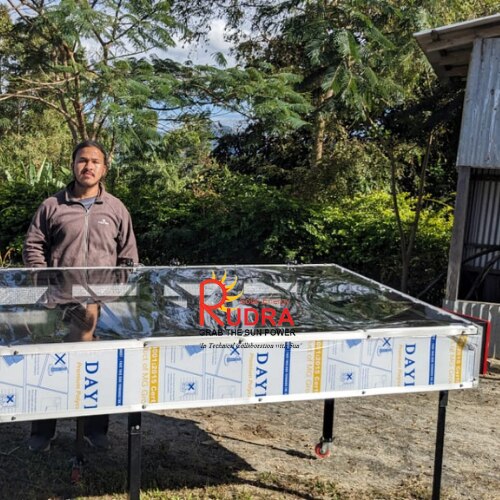
This diversity makes solar drying in Arunachal Pradesh particularly relevant for value-addition activities where farmers, producer groups and processors need to reduce moisture from seasonal agricultural produce before appropriate storage or further processing.
From Fresh Mountain Produce to Stable Dried Ingredients
Solar drying is fundamentally a moisture-removal process.
Fresh fruits, spices, herbs and other agricultural products contain different amounts of water and behave differently during drying. A suitable drying process therefore needs to consider:
- initial moisture content
- desired final moisture
- commodity structure
- slice or piece thickness
- product preparation
- tray loading
- airflow
- drying temperature
- relative humidity
- available solar radiation
- local weather conditions
There is no single drying time or temperature that should be applied to every crop grown in Arunachal Pradesh.
Kiwi Drying: A Distinct Arunachal Pradesh Opportunity
Kiwifruit gives this state a particularly strong and distinctive horticultural identity.
ICAR identifies Ziro Valley in Lower Subansiri as a key kiwifruit-growing area and also notes kiwi cultivation in West Kameng, Lower Dibang Valley, Si-Yomi, Kamle, Papum Pare and Pakke Kessang.
MoFPI's ODOP framework separately identifies kiwi-based products for Lower Subansiri, Shi Yomi and Dibang Valley.
For suitable kiwi-drying applications, processing may include separate preliminary steps such as:
sorting → washing → peeling where required → slicing → tray loading → drying
The drying stage then removes moisture from the prepared fruit.
Uniform slicing is particularly important because thick and thin pieces can lose moisture at different rates. Excessive tray loading may also restrict air movement around the fruit.
Solar drying may therefore support processors exploring dried kiwi slices or kiwi ingredients, while packaging, storage, powdering or other product-development steps remain separate operations.
Ginger and Turmeric Need a Different Drying Strategy
Arunachal Pradesh also has strong spice-processing relevance.
Government ODOP data identifies ginger-based products in Longding, Lower Dibang Valley and Pakke Kessang, while turmeric is identified for Namsai, Papum Pare and Lower Siang.
ICAR material also documents ginger and turmeric within agricultural systems in Arunachal Pradesh.
Unlike sliced fruit, rhizomes such as ginger and turmeric may require commodity-specific preparation before drying.
Depending on the intended product, preparation can separately involve cleaning, cutting or slicing and other appropriate processing operations.
The actual drying stage should then focus on:
- appropriate product thickness
- controlled loading depth
- adequate airflow
- movement of moisture away from the product
- monitoring of drying progress
- achieving the required moisture endpoint
Grinding ginger or turmeric into powder occurs after drying and should not be presented as a function of the solar drying system itself.
Orange, Apple and Other Hill Fruits
Arunachal Pradesh's food-processing potential extends beyond kiwi.
MoFPI identifies orange-based products for Upper Siang and Upper Subansiri, apple-based products for West Kameng and pineapple-based products for West Siang.
This creates additional solar drying applications for suitable fruit-processing enterprises.
Different fruits should not be loaded or operated under identical conditions.
For example, drying behaviour may vary according to:
fruit maturity + water content + preparation + slice thickness + tray utilisation + humidity + final product requirement.
A fruit processor handling several seasonal crops may potentially use the same appropriately designed drying system at different times, but operating conditions should be adjusted for each commodity.
Large Cardamom and Spice Drying
The ODOP list also identifies large cardamom in Arunachal Pradesh districts including Kurung Kumey, Siang and Anjaw.
Spices require careful drying because moisture reduction is only one part of the overall processing chain.
For spice drying, attention should be given to:
- raw material condition
- airflow through the product
- loading density
- suitable operating temperature
- local humidity
- desired final moisture
- subsequent storage conditions
Solar drying can support the moisture-reduction stage without implying that the process automatically guarantees colour, flavour, food safety or market quality.
Why Arunachal Pradesh Weather Matters During Solar Drying
Arunachal Pradesh's mountainous geography means drying conditions can vary substantially across locations and seasons.
For solar drying, relative humidity, cloud cover, solar radiation and ambient weather directly influence the rate at which moisture can be removed.
During humid or low-solar conditions, drying may proceed more slowly than during favourable sunny weather.
This makes airflow especially important.
Heating the product alone is not sufficient. Moisture released by the commodity must also be carried away from its surface.
Where processing schedules require greater continuity, an appropriately designed backup or hybrid arrangement may be evaluated, but weather-independent performance should not be assumed.
Thin Layers Matter More Than Heavy Tray Loading
One of the most common operational mistakes in drying is trying to maximize kilograms on each tray.
More product on a tray does not automatically mean more effective drying.
When products are loaded too densely:
- air may not move evenly
- moisture can remain trapped between pieces
- different portions of the batch may dry differently
- drying time may increase
This is especially relevant when switching between dense rhizomes such as ginger and turmeric and lighter sliced fruits.
Usable tray area and airflow can be as important as nominal batch capacity.
Solar Drying Applications Relevant to Arunachal Pradesh
Based on the state's documented horticultural and food-processing profile, useful areas for solar drying may include:
- kiwi and other fruits
- orange and citrus products
- apple
- pineapple
- ginger
- turmeric
- large cardamom
- selected herbs
- suitable vegetables
- other agricultural produce where controlled moisture reduction is required
The correct process should always be selected according to the commodity rather than applying one generic drying method to every product.
Solar Drying for Farmer Groups and Local Processing
For growers and producer organisations, drying can create an additional processing pathway when fresh produce cannot all be marketed immediately.
However, a successful value-addition activity requires more than drying equipment alone.
Processors also need to plan for:
- raw-material selection
- hygienic preparation
- drying endpoint
- post-drying cooling where appropriate
- suitable packaging
- storage
- quality checks
- market requirements
Solar drying should therefore be understood as one technical stage in the wider post-harvest value chain.
Building Better Solar Drying Practices in Arunachal Pradesh
Arunachal Pradesh does not need another generic location page saying that “solar drying is useful for farmers.”
Its real opportunity lies in matching drying practices to the state's distinctive commodities.
Kiwi requires fruit-specific slicing and tray utilisation.
Ginger and turmeric require rhizome-focused moisture management.
Large cardamom requires spice-specific drying control.
Orange, apple and pineapple each require their own fruit preparation and drying conditions.
This commodity-specific approach is more useful for processors and better reflects how solar drying actually works.
Rudra Solar Energy's Application Approach
Rudra Solar Energy Pvt. Ltd. works with solar drying applications for agricultural and food-processing requirements.
For a project in Arunachal Pradesh, drying-system selection can be evaluated according to:
commodity → fresh quantity → preparation → moisture load → tray area → airflow → local weather → required final moisture.
Depending on the selected configuration, enclosed drying chambers, controlled or forced airflow, food-contact trays and optional hybrid support may be considered according to the processing requirement.
The objective is not to apply one standard dryer setting to every Arunachal Pradesh crop, but to build the drying process around the behaviour of the commodity and the actual moisture-removal requirement.
Closing
From kiwi-growing areas such as Ziro Valley to ginger, turmeric, large cardamom, orange, apple and pineapple processing clusters, Arunachal Pradesh has a diverse range of commodities where well-managed solar drying can support post-harvest processing and value addition.
A technically sound solar drying process begins with understanding the product—not simply selecting a machine by capacity.
For growers, FPOs and processors evaluating solar drying in Arunachal Pradesh, the most useful starting information is the commodity, fresh batch quantity, preparation method and desired moisture-reduction requirement.