
Solar Drying in Goa: A Practical Approach to Moisture Management
Goa is widely known for tourism, but the state also has an important agricultural and horticultural base that includes coconut, cashew, mango, banana, pineapple, kokum, arecanut, spices and other tropical produce. Many of these commodities contain significant moisture at harvest and may require drying as part of post-harvest handling, storage preparation or value addition.
Solar drying in Goa offers a practical method of using available solar energy to support moisture removal from suitable agricultural and food products inside a more organised drying environment.
Unlike open-air sun drying, where produce is directly exposed to surrounding dust, insects, animals and sudden weather changes, an enclosed solar drying system can provide a protected chamber with planned tray arrangement and airflow.
However, solar drying should not be treated as one fixed recipe for every crop. Kokum rind, coconut, chilli, turmeric, mango slices and lightweight herbs behave differently during drying. Their preparation, initial moisture, thickness, loading density, airflow requirement and desired final moisture can all vary.
For Goa, this commodity-specific approach is especially important because tropical and coastal conditions can influence drying performance.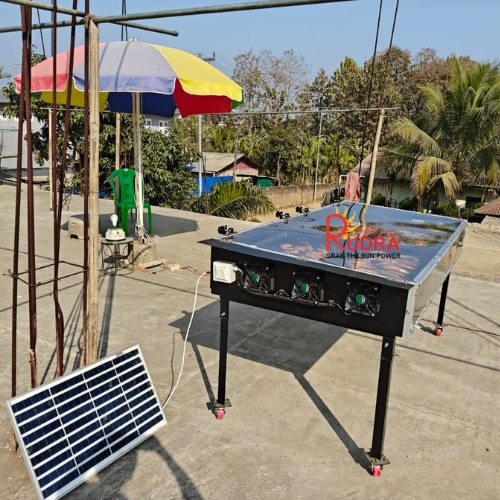
Why Goa Needs Commodity-Specific Solar Drying
The success of a drying process depends on more than simply exposing a product to heat.
Moisture must move from inside the material toward its surface and then be carried away by moving air. If trays are overloaded, pieces are cut unevenly or humid air cannot leave the drying chamber efficiently, drying may slow considerably.
This is why solar drying applications in Goa should be planned around several practical factors:
- type of commodity
- initial moisture
- size and thickness of the material
- pre-drying preparation
- tray loading
- airflow
- drying temperature
- relative humidity
- available solar radiation
- desired final moisture condition
A well-planned process aims to create suitable conditions for moisture removal while keeping the commodity protected from unnecessary outdoor exposure.
There is no technically correct universal statement such as “all products dry in a fixed number of hours.” Actual drying time can vary substantially according to product and weather conditions.
Solar Drying of Kokum in Goa
Kokum is one of the most distinctive products associated with the Konkan region, including Goa.
After suitable preparation, kokum rind may require moisture reduction before storage or further processing. Because the rind can contain considerable moisture, the way it is arranged inside the drying system can influence how effectively air reaches the material.
For solar drying of kokum, processors should pay attention to:
consistent preparation of the rind, suitable tray loading, adequate spacing, airflow across the product and the humidity of the incoming and outgoing air.
Placing excessively thick layers of material on trays may restrict airflow around the product and create differences between pieces within the same batch.
An enclosed solar drying environment can help organise the process while reducing direct exposure to outdoor dust and insects.
Drying is still only one stage of kokum processing. Cleaning, preparation, grading, packaging and storage should be treated as separate operations.
Coconut and Copra Drying Applications
Coconut is another highly relevant commodity for Goa.
Depending on the intended product, moisture reduction may be required for coconut pieces or copra-related processing. Coconut-based products have different moisture characteristics from thin fruit slices or lightweight leaves, so system loading should be adapted accordingly.
For solar drying of coconut, processors should consider the size of the coconut pieces, initial moisture level, tray arrangement and movement of heated air through the chamber.
Dense loading should be avoided where it prevents air from reaching the drying surface effectively.
The objective is not simply to achieve a high chamber temperature. Drying requires a balance between heat and effective moisture-carrying airflow.
A chamber that becomes hot but does not remove moisture-laden air efficiently may not provide the expected drying performance.
Cashew and Solar Drying in Goa
Cashew is strongly associated with Goa's agricultural economy, but the term “cashew drying” can describe different processing requirements depending on the material being handled.
Cashew nuts and cashew-related by-products should therefore not automatically be assigned the same drying method.
Any solar drying application should first define:
What exactly is being dried?
This is an important technical question.
The drying requirement for a fruit component, botanical material or processed cashew-related ingredient can differ significantly in moisture content and physical structure.
Solar drying systems should therefore be selected and operated according to the specific material rather than simply using the commodity name as the only processing parameter.
Solar Drying of Mango, Banana and Pineapple
Goa's tropical conditions support several fruit crops that may also have potential for dried-product processing.
Mango, banana and pineapple contain relatively high moisture when fresh. Before drying, they generally require separate preparation appropriate to the intended product.
Preparation may include operations such as washing, peeling, cutting or slicing where required.
These steps occur before solar drying and should not be confused with the drying process itself.
For sliced fruit, thickness is particularly important.
Two trays containing the same weight of mango but with very different slice thicknesses may not dry at the same rate.
A more consistent drying batch can be supported by maintaining reasonably uniform preparation and tray loading.
A solar drying system for fruits can then use solar-heated air and controlled airflow to support gradual moisture removal from the prepared material.
Solar Drying of Spices in Goa
Goa's agricultural diversity also includes spices such as black pepper, turmeric and other tropical spice crops.
Spices require careful drying because different products vary significantly in structure and initial moisture.
Turmeric, for example, may undergo preparation processes before it reaches the drying stage. Drying should therefore not be described as a replacement for curing, cleaning or grinding.
Black pepper has a very different physical form and airflow behaviour compared with sliced turmeric.
For solar drying of spices in Goa, tray depth and airflow should be adjusted according to the product rather than keeping identical loading practices for every spice.
The purpose of the drying stage is to reduce moisture toward the condition required for subsequent handling and storage.
Coastal Humidity and Solar Drying Performance
One of the most important considerations for solar drying in Goa is humidity.
Warm air can hold moisture, but when ambient relative humidity is high, the ability of incoming air to absorb additional moisture from the product can be reduced.
This means drying performance may change across seasons and even during different parts of the same day.
During periods of stronger solar radiation and favourable humidity, moisture removal may progress more quickly.
During cloudy, rainy or highly humid conditions, drying may slow.
An enclosed solar drying chamber can protect produce from direct rain, but it should not be described as completely weather-independent.
For processors requiring greater operating flexibility, hybrid or backup-assisted configurations may be considered depending on their production requirement.
Why Airflow Is Critical in Solar Drying
Airflow is one of the most important parts of the solar drying process.
As moisture leaves the commodity, the surrounding air becomes more humid. This moisture-laden air needs to move away from the product so that further moisture removal can continue.
Poor airflow may create uneven conditions between different trays or parts of the chamber.
For this reason, an effective drying process considers:
air entry, air movement across the trays, spacing between products and removal of humid exhaust air.
In relevant solar drying configurations, powered airflow can help maintain air movement through the chamber.
However, increasing fan speed alone is not a universal solution. Airflow should be appropriate for the commodity and loading arrangement.
Correct Tray Loading for Better Solar Drying
Tray loading directly influences how easily air can reach the product.
A common mistake in drying operations is attempting to load as much material as possible onto a limited tray area.
Overloading may reduce the exposed surface area of individual pieces and restrict airflow.
For suitable fruits and vegetables, reasonably uniform slices arranged in controlled layers can support more consistent drying.
Lightweight herbs or leaves may require a different approach because strong airflow could disturb the product.
Larger or denser materials may require additional spacing.
This is why usable tray area can sometimes be more informative than simply discussing the outer size of the drying chamber.
Open Sun Drying and Enclosed Solar Drying
Open sun drying has been used traditionally because it is simple and requires little equipment.
However, the product is directly exposed to the external environment.
An enclosed solar drying process creates a defined drying space where produce is arranged on trays and heated air is moved through or around the product.
This can help reduce direct exposure to environmental contaminants such as dust and insects compared with completely open drying.
The comparison should not be exaggerated into a claim that solar drying automatically guarantees food safety or a particular final product quality.
Final results still depend on raw material quality, preparation, hygiene, drying control, final moisture, packaging and storage.
Solar Drying for Farmers and Rural Producers in Goa
Solar drying can be relevant to farmers who want to explore post-harvest handling beyond immediate sale of fresh produce.
During harvest periods, perishable fruits and vegetables may have a relatively short marketing window.
Drying suitable portions of produce may support development of shelf-stable ingredients or products when appropriate processing and packaging practices are followed.
Potential users in Goa may include:
farmers, small processors, women's groups, rural entrepreneurs, cooperatives, FPOs, food-processing businesses and institutions working with agricultural value addition.
The required drying scale will differ for every user.
A household-scale requirement cannot automatically be compared with a processor handling several hundred kilograms of fresh produce.
Solar Drying for Food-Processing Businesses
Food-processing businesses may require greater consistency in daily loading and workflow.
Before choosing a drying system, processors should identify:
- commodities to be handled
- kilograms of fresh material per batch
- number of batches
- operating season
- product preparation
- desired final moisture
- available processing space
- requirement during cloudy periods
A system should then be sized around the actual drying requirement.
Simply purchasing the largest available unit does not necessarily result in the most efficient process if the tray area and airflow pattern do not match the normal batch size.
Can One Solar Drying System Handle Multiple Products?
A solar drying system may be used for different suitable commodities at different times, provided the operating procedure is adjusted for each product.
For example, a processing enterprise in Goa might work with mango during one period, kokum during another and spices at another time.
However, this does not mean all three products should use identical drying conditions.
The processor may need to adjust preparation, loading depth, airflow, monitoring and endpoint assessment.
Proper cleaning between different product batches is also an important operational practice.
Understanding the End Point of Drying
Drying should not be stopped simply because the outside of a product “looks dry.”
The surface may lose moisture faster than the interior.
For commercial processing, the endpoint should be evaluated according to the commodity and intended storage requirement.
Where appropriate, moisture measurement can provide more reliable information than visual appearance alone.
After drying, the product should also be handled carefully because warm dried material can interact with surrounding humid air.
Cooling and suitable packaging practices should therefore follow the drying stage.
Solar Drying and Post-Harvest Value Addition in Goa
Solar drying can form part of a broader post-harvest value-addition system.
For example:
fresh fruit may be prepared and dried before packaging as a dried product.
Spices may be dried before subsequent grading or grinding.
Herbs may be dried before storage or further processing.
Coconut and forest-based products may follow their own specific processing sequences.
The important point is that solar drying performs moisture reduction.
It should not be presented as performing every other food-processing operation.
Clear separation of processing stages improves both technical accuracy and user understanding.
Role of Rudra Solar Energy in Solar Drying Applications
Rudra Solar Energy develops solar drying systems for different agricultural, food-processing and other suitable drying applications.
System selection can be planned according to the commodity, fresh input quantity, available tray area, airflow requirement, operating conditions and processing objective.
For Goa, a drying requirement based on kokum may be different from one based primarily on coconut, spices or tropical fruits.
Understanding the actual commodity and batch requirement first helps in selecting a more appropriate drying configuration.
Depending on the application, solar-powered airflow and optional hybrid or backup arrangements may also be considered in relevant systems.
Building a Stronger Solar Drying Ecosystem in Goa
Goa has an opportunity to combine its agricultural diversity with practical post-harvest processing.
Kokum, coconut, cashew-related products, tropical fruits and spices each represent different drying challenges, but they share one common requirement: moisture must be managed appropriately before many products can be stored or processed further.
Solar drying can support this requirement by using solar energy within a more organised drying environment.
For farmers and processors, the most effective approach is not to search for one universal drying formula.
Instead, solar drying should be designed around the commodity, moisture level, preparation, loading, airflow, climate and intended final product.
Conclusion
Solar drying in Goa can support moisture management for a wide range of suitable agricultural and horticultural products, including kokum, coconut, tropical fruits and spices.
The greatest benefit comes when the process is treated technically rather than simply as exposure to solar heat.
Good preparation, appropriate tray loading, sufficient airflow, awareness of humidity and correct assessment of the drying endpoint all contribute to a more organised drying process.
With Goa's combination of tropical horticulture, plantation crops and spice production, commodity-specific solar drying can become a useful component of post-harvest management and agricultural value addition.
For every application, the drying system and operating method should ultimately be selected according to the actual product and processing requirement rather than relying on one standard drying time, temperature or capacity for all commodities.