
Jammu & Kashmir has one of India’s most distinctive horticultural economies, known for apples, walnuts, almonds, cherries, pears, plums, saffron, vegetables, medicinal plants and other fresh and dry horticultural produce. The J&K Economic Survey 2025–26 reports horticulture production of about 26.92 lakh metric tonnes in 2024–25, while the UT also has a substantial fresh- and dry-fruit trade. Solar drying in Jammu & Kashmir can complement this horticultural ecosystem by providing a controlled moisture-reduction process for suitable fruits, nuts, herbs, spices, vegetables and other prepared materials where drying forms part of the intended post-harvest pathway.
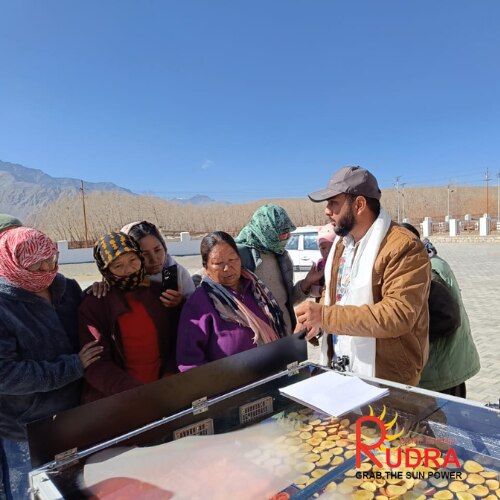
Why is solar drying relevant to Jammu & Kashmir’s horticulture sector?
Horticulture is a major part of Jammu & Kashmir’s agricultural economy. The Horticulture Planning and Marketing Department identifies fresh fruits, dry fruits, saffron, flowers and other specialty produce as important parts of the region’s horticultural identity.
The UT also faces a distinctive post-harvest situation:
- Large seasonal fruit arrivals
- High-value orchard crops
- Cold winters in many areas
- Variable humidity and rainfall
- Short harvest windows for some commodities
- Long-distance movement to major markets
- Strong fresh-fruit as well as dry-fruit value chains
Solar drying can provide another processing route for material that is technically suitable for dehydration.
However, it should not be presented as a replacement for every other post-harvest technology.
Is solar drying a replacement for cold storage in Jammu & Kashmir?
No. Cold storage and solar drying serve different purposes.
Jammu & Kashmir has invested substantially in Controlled Atmosphere and cold-storage infrastructure for fresh horticultural produce. The 2025–26 Economic Survey reports around 2.92 lakh MT of CA-storage capacity, with further expansion planned.
Cold storage aims to retain suitable produce in a fresh condition.
Solar drying deliberately removes moisture to create a dried product or processing ingredient.
For example:
Fresh premium apple → cold storage may be appropriate
while
apple intended for dried slices → drying is required
The two technologies can therefore be complementary parts of the horticultural value chain.
Which products can be considered for solar drying in Jammu & Kashmir?
Depending on preparation and required end use, relevant applications can include:
Apple
Cherry
Pear
Plum
Apricot
Peach
Walnut-related materials where drying is technically required
Almond-related materials
Saffron
Black Cumin
Medicinal Plants
Aromatic Herbs
Mushrooms
Selected Vegetables
Other suitable horticultural produce
Official J&K horticulture information specifically identifies apples, walnuts, almonds, saffron and other fresh/dry fruits as characteristic products of the region.
Each commodity requires its own drying approach.
Can apples be solar dried in Kashmir?
Yes. Properly prepared apples can be dried where dehydration is part of the desired final product.
Apple preparation may include:
Sorting
Washing
Peeling where required
Core removal
Slicing
Suitable pretreatment where required
Tray loading
Drying
Cooling
Packaging
The Solar Dryer performs the moisture-removal stage.
Jammu & Kashmir has a particularly strong apple economy, and the government continues to invest in high- and medium-density orchards and market infrastructure around horticultural production.
Can lower-grade or surplus apples be used for drying?
Potentially, yes — provided the fruit remains safe and suitable for food processing.
There is an important distinction between:
Grade-out fruit suitable for processing
and
spoiled, mouldy or unsafe fruit
Drying cannot make already unsafe material safe.
Suitable processing-grade apples may be sorted and converted into products such as dried slices or ingredients for further processing.
Food safety and raw-material selection remain necessary before drying.
Does apple slice thickness affect solar drying?
Yes.
Slice thickness affects:
Surface area
Moisture movement
Tray occupancy
Drying duration
Product texture
Very thick pieces generally present a longer path for moisture to move from inside the apple toward the surface.
Uniform slicing also helps different pieces behave more consistently during drying.
However, there is no universal “best” slice thickness for every dried-apple product.
How long does apple solar drying take in Jammu & Kashmir?
There is no universal fixed drying time.
Drying duration depends on:
Apple Variety
Ripeness
Initial Moisture
Target Final Moisture
Slice Thickness
Pretreatment
Tray Loading
Airflow
Temperature
Relative Humidity
Solar Radiation
Season
Dryer Design
A technically accurate solar-drying page should therefore avoid promising one fixed number of hours for all apple batches.
Can cherries, plums and apricots be solar dried?
Yes, suitable prepared stone fruits may be considered for solar drying.
Relevant products may include:
Cherry
Plum
Apricot
Peach
Each has different:
Fruit Size
Skin Characteristics
Sugar Content
Initial Moisture
Preparation Requirement
Final Texture Objective
Whole fruit, halved fruit and sliced fruit can behave differently during drying.
Preparation should therefore be designed around the desired finished product.
Can walnuts be dried using solar energy?
Suitable walnut material may require moisture management as part of post-harvest handling, but the process must be described carefully.
Walnut processing can involve separate operations such as:
Harvesting
Husk removal
Cleaning
Drying where required
Shelling
Kernel grading
Packaging
The dryer performs only the appropriate moisture-reduction stage.
Jammu & Kashmir treats walnuts as an important dry-fruit crop, and the UT’s horticultural strategy continues to emphasise walnut cultivation alongside apple and other premium fruit crops.
Is drying whole walnuts the same as drying walnut kernels?
No.
Whole walnuts in shell and separated kernels have different physical structures and processing requirements.
Their differences can include:
Moisture movement
Surface exposure
Airflow
Layer depth
Temperature sensitivity
Required final moisture
Storage requirement
For this reason, a drying process should clearly identify whether the material is:
walnut in shell
or
walnut kernel
before operating conditions are selected.
Can almonds also be processed through solar drying?
Where moisture reduction is required, appropriate almond material may be considered.
But, as with walnuts, drying is only one part of the complete handling chain.
Sorting, shelling, grading and packaging remain separate processes.
J&K’s official horticulture marketing department categorises almonds and walnuts among the UT’s dry-fruit products.
Can saffron be solar dried?
Saffron requires particularly careful drying and post-harvest handling because it is a high-value, delicate product.
Jammu & Kashmir’s horticulture department specifically identifies saffron among the UT’s signature horticultural commodities.
For saffron, drying should focus on controlled conditions rather than maximum heat.
Important variables may include:
Fresh stigma condition
Loading density
Temperature
Airflow
Drying duration
Final moisture
Protection from contamination
Post-drying storage
The highest temperature a solar drying system can generate should not automatically be used for saffron.
Does solar drying guarantee saffron colour, aroma or quality?
No universal guarantee should be made.
Saffron quality can be influenced by:
Raw material
Harvest timing
Handling
Drying temperature
Drying duration
Moisture
Storage
Packaging
Solar drying provides a means of moisture removal, but the drying equipment alone cannot guarantee grade, aroma strength or chemical quality.
These should be determined according to appropriate product standards and testing where required.
Can medicinal plants and aromatic herbs be solar dried in Jammu & Kashmir?
Yes, suitable medicinal and aromatic plant materials can undergo controlled drying when dehydration is required.
But leaves, roots, stems, flowers and other plant parts can behave very differently.
Important variables include:
Plant Species
Plant Part
Initial Moisture
Material Thickness
Temperature Sensitivity
Tray Layer Depth
Airflow
Desired Final Moisture
The dryer should not be described as guaranteeing medicinal potency or therapeutic properties.
It performs moisture reduction, not pharmaceutical validation.
Can mushrooms be solar dried?
Yes, suitable mushrooms can be dried where dehydration forms part of the intended processing method.
Mushrooms typically contain considerable moisture and may require careful preparation and loading.
Important factors include:
Mushroom Type
Freshness
Whole or Sliced Form
Slice Thickness
Tray Loading
Temperature
Airflow
Target Moisture
The J&K horticulture ecosystem also recognises specialty products such as morels and other high-value horticultural materials.
Why is airflow important in fruit and nut drying?
Solar heat helps moisture move from the material, but heat alone does not complete drying.
As moisture leaves apples, herbs or another commodity, it enters the surrounding air.
That moisture-bearing air needs to move away.
Therefore drying depends on:
Heat + Airflow + Product Surface Area + Layer Depth + Humidity
Poor airflow can slow drying even when chamber temperature is high.
Why should trays not be overloaded?
Overloading can restrict movement of air around the material.
This may result in:
Longer drying time
Uneven moisture removal
Moisture pockets
Greater difference between individual pieces
Practical drying capacity should therefore consider usable tray area, not kilograms alone.
Does the same kilogram capacity apply to apples, saffron and herbs?
No.
For example, 20 kg of apple slices and 20 kg of lightweight leafy herbs occupy completely different volumes and surface areas.
Saffron is an even more specialised low-mass, high-value material.
Practical capacity is influenced by:
Fresh Weight
Bulk Density
Product Size
Initial Moisture
Required Layer Depth
Tray Area
Airflow
This is why a solar drying application should be sized around the actual material.
Can one solar drying system process fruits, herbs, saffron and vegetables?
A suitable system may handle different compatible commodities in separate batches.
However, one machine does not mean one universal drying procedure.
Apple slices
Walnuts
Leafy herbs
Saffron
Vegetables
Mushrooms
can require different:
Preparation
Temperature
Tray Loading
Airflow
Drying Duration
Final Moisture
Cleaning between different products is also important.
How does cold mountain weather affect solar drying?
Lower ambient temperatures can affect the amount of useful heat generated inside a solar drying system.
Drying performance is also influenced by:
Solar radiation
Cloud cover
Ambient temperature
Humidity
Wind
Season
Location
Elevation
Therefore, solar drying in a mountain or temperate environment should not be described as completely weather-independent.
The actual system and production schedule should account for local conditions.
Can solar drying work during cloudy weather or winter?
Solar-only systems depend on available solar radiation.
When sunlight is limited, drying performance can reduce.
For applications requiring predictable commercial scheduling, an appropriate hybrid or backup heat configuration may be used where available.
The objective of hybrid support is to provide additional heat when solar energy is insufficient.
It does not eliminate the importance of:
Airflow
Correct loading
Product preparation
Moisture monitoring
Is enclosed solar drying different from open-air drying?
Yes.
Open-air drying directly exposes material to the surrounding environment.
An enclosed solar drying system can provide:
Organised tray loading
Reduced direct exposure to dust
Reduced access by insects
Reduced access by birds and animals
Better separation from the ground
More controlled air movement
However, enclosed drying alone does not guarantee food safety or final quality.
Raw-material hygiene, cleaning, preparation, final moisture and packaging remain important.
Can solar drying help during peak apple harvest?
It may provide an additional value-addition pathway for processing-grade material that is suitable for dehydration.
However, solar drying should not be portrayed as the main solution for all fresh apples.
J&K’s horticultural system includes fresh-market channels, cold storage, Controlled Atmosphere storage and processing routes. The 2025–26 Economic Survey reports substantial fresh-fruit output and continued expansion of post-harvest infrastructure.
Solar drying fits within this wider system as one possible processing method.
Can dried apples later be converted into powder?
Yes, where the dried material is suitable for that purpose, but powder production requires separate processing.
A typical sequence can be:
Apple Preparation → Drying → Cooling → Grinding/Milling → Sieving → Packaging
The solar dryer performs only the drying stage.
The same principle applies to vegetable powders, herbal powders and other ingredients.
How should final moisture be checked?
Drying completion should ideally be based on the required final product condition rather than visual appearance alone.
Possible approaches include:
Weight monitoring
Suitable moisture measurement
Product-specific moisture specification
Laboratory analysis where required
Final moisture is especially important before packaging and storage.
A product that appears dry on the surface may still contain more internal moisture than required.
Can solar drying create export-quality products automatically?
No.
Jammu & Kashmir has an important fresh- and dry-fruit trade. The 2025–26 Economic Survey reports substantial revenue from fresh and dry-fruit exports, including almonds and walnuts.
But drying equipment alone cannot establish export quality.
Export suitability can additionally depend on:
Commodity grade
Final moisture
Contaminant limits
Food safety
Residues
Microbiology
Packaging
Traceability
Buyer requirements
Applicable standards
Solar drying should therefore be positioned as one processing stage within the full quality-management chain.
Can solar drying support FPOs, orchard growers and small processors?
Yes, when the business has a suitable commodity and defined dried-product market.
Potential users include:
Apple Growers
Orchard Owners
Walnut Producers
Saffron Growers
FPOs and FPCs
SHGs
Farmer Cooperatives
Small Food Processors
Herbal Businesses
Dry-Fruit Processors
Rural Entrepreneurs
Food-Processing MSMEs
J&K’s horticultural marketing framework also links growers and processors with schemes including PMFME, agricultural infrastructure programmes and e-NAM.
What should be evaluated before starting a solar drying project in Jammu & Kashmir?
Before selecting a process, identify:
Commodity
Fresh Quantity
Initial Moisture
Target Moisture
Preparation Method
Plant or Fruit Part
Slice Thickness
Usable Tray Area
Required Layer Depth
Airflow
Temperature Sensitivity
Season of Operation
Solar Availability
Need for Backup Heat
Daily Throughput
Packaging
Storage
Buyer Requirement
The correct system begins with the product and process, not simply a kilogram capacity.
Solar Drying in Jammu & Kashmir: Adding Another Pathway to Horticultural Value Addition
Jammu & Kashmir’s horticultural strength is built around high-value fresh and dry produce, including apples, walnuts, almonds, cherries, pears, plums, saffron and other specialty crops. The UT’s latest Economic Survey shows continued growth in horticulture production, market integration, cold-storage capacity and food-processing infrastructure.
Solar drying can complement this ecosystem where controlled moisture reduction is technically appropriate. For apple slices, suitable nut-processing stages, herbs, saffron, mushrooms, vegetables and other compatible materials, effective drying should be based on commodity preparation, initial moisture, tray loading, airflow, temperature, weather and required final moisture rather than one fixed time or temperature.