


Ladakh’s cold-arid environment creates a distinctive solar-drying opportunity. The region receives strong sunlight, yet its high altitude, cool air, strong winds and sharp day-to-night temperature changes make open drying difficult to standardise.
Apricot is central to Ladakh’s horticultural economy, while apple, seabuckthorn, walnut, buckwheat, vegetables, pulses, zeera and medicinal herbs offer additional processing possibilities. Solar drying can help convert suitable seasonal produce into stable ingredients and packaged foods when harvesting, preparation, drying, moisture testing and packaging are managed as one connected process.
The Horticulture Department of Ladakh reports approximately 2,612 hectares under apricot cultivation with annual production of 15,868 metric tonnes. Important cultivars include Halman, Raktsey Karpo, Khantay and Narmoo. The department also reports approximately 866 hectares of apple cultivation with annual production of 5,172 metric tonnes.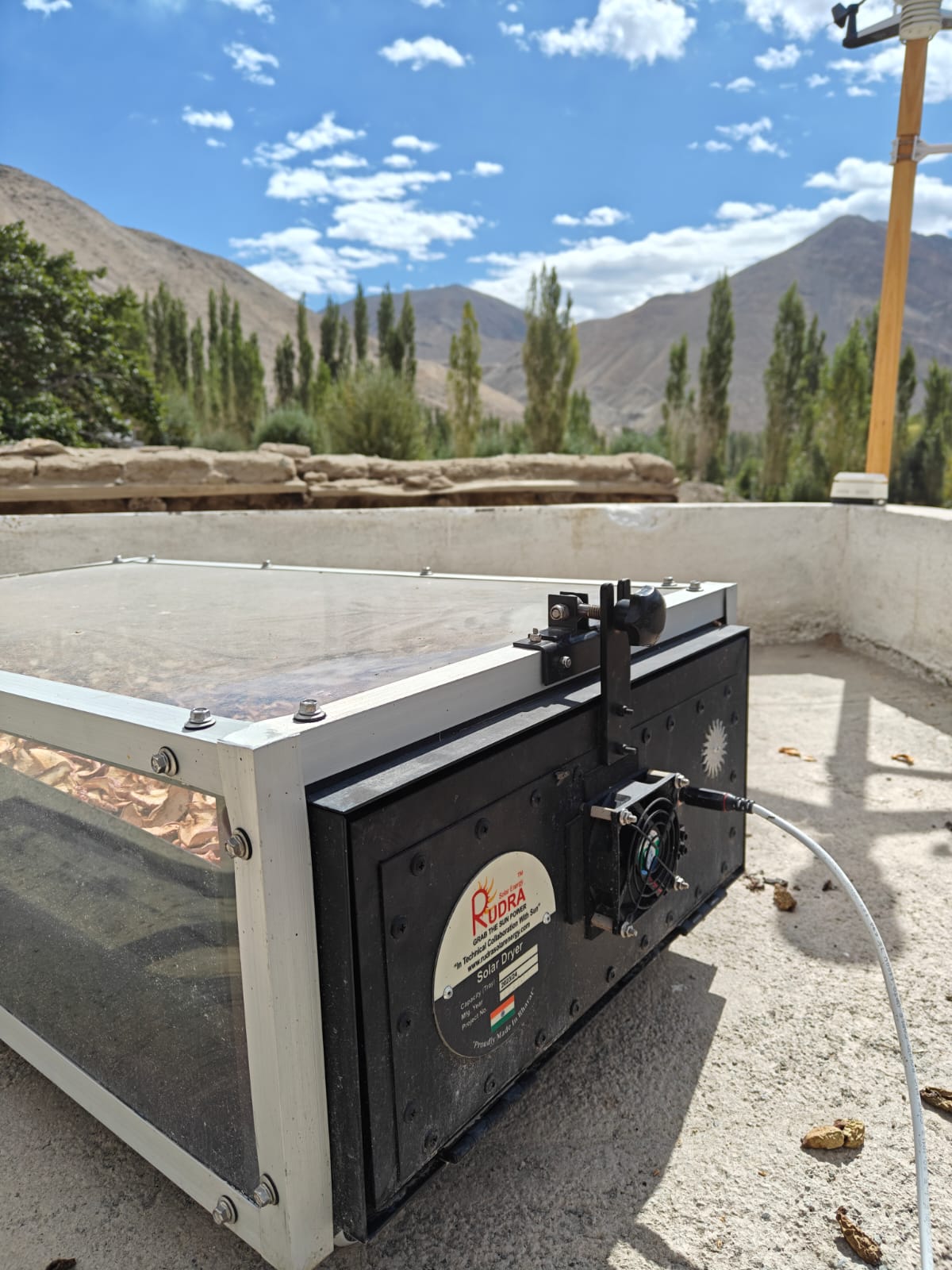
Why Is Solar Drying Relevant in Ladakh Despite Abundant Sunshine?
Ladakh has good solar availability, but strong sunlight alone does not create a controlled drying process. Traditional rooftop or open-ground drying may expose fruits and herbs to dust, wind-blown material, insects, birds and repeated handling.
Intense solar radiation can also heat the product surface too quickly. If surface moisture is removed much faster than internal moisture can migrate outward, the material may develop a dry outer layer while retaining moisture inside. This is one reason airflow and temperature monitoring matter even in a dry climate.
An enclosed solar-drying system can provide:
- Protection from direct outdoor contamination
- Organised tray-based loading
- Better control over product thickness and batch depth
- Managed removal of moisture-laden air
- Reduced risk of wind scattering lightweight produce
- Easier monitoring of temperature, weight loss and drying progress
Solar drying remains weather-dependent. Low ambient temperatures, cloudy periods and cold evenings can slow the process even when daytime sunlight is strong.
Which Ladakh Products Can Be Considered for Solar Drying?
Important solar-drying applications in Ladakh may include:
- Apricot halves, slices and prepared pulp
- Raw apricot slices for sour powders or ingredients
- Apple rings and slices
- Selected walnut and apricot kernels
- Seabuckthorn berries, leaves or processing residue
- Buckwheat and small grain batches
- Pulses and seed lots
- Leafy vegetables and seasonal vegetables
- Zeera and selected aromatic herbs
- Medicinal and high-altitude plants
- Prepared ingredients for local foods and herbal products
Not every commodity should use the same drying conditions. Fruit, seeds, kernels, leaves and roots differ in moisture content, structure, oil content, heat sensitivity and intended final use.
How Should Apricots Be Prepared for Solar Drying?
Sound and appropriately mature apricots should first be sorted to remove damaged, mouldy or insect-affected fruit. The selected fruit should then be washed using safe water and drained before cutting or pitting.
A practical apricot-drying process may include:
- Harvesting and handling fruit carefully to minimise bruising
- Sorting by maturity, size and physical condition
- Washing and allowing surface water to drain
- Removing the stone where required
- Cutting fruit into uniform halves or slices
- Applying a validated pre-treatment when the intended product requires it
- Loading fruit in a single layer without excessive overlap
- Monitoring temperature, airflow and product weight during drying
- Confirming the final moisture or water activity
- Cooling the dried product before packaging
- Packing in a suitable moisture-resistant material
Whole apricots, halves, slices and apricot pulp do not dry at the same rate. Larger pieces create a longer internal path for moisture movement. Drying time should therefore be established through product trials rather than copied from a universal chart.
Does Apricot Variety Affect the Drying Process?
Yes. Apricot varieties can differ in fruit size, skin characteristics, sugar content, acidity, pulp thickness, firmness and stone separation. These differences influence preparation, drying behaviour, colour development and final texture.
Halman and the GI-tagged Raktsey Karpo should not automatically be assigned the same drying schedule. Initial trials should record:
- Fresh weight
- Fruit size and slice thickness
- Loading density
- Drying-air temperature
- Relative humidity
- Time and weather conditions
- Intermediate and final weight
- Final moisture or water activity
- Colour, texture and packaging behaviour
This documented approach is more reliable than judging dryness only by touch or appearance.
Can Solar Drying Improve the Appearance of Dried Apricots?
Protected and appropriately controlled drying may help reduce exposure-related contamination and uncontrolled darkening compared with poorly managed open drying. However, attractive colour is not guaranteed by the equipment alone.
Apricot colour can be affected by variety, maturity, bruising, cutting, oxygen exposure, enzyme activity, temperature, drying duration and any pre-treatment used.
If chemical pre-treatments are considered, they must comply with applicable food regulations, labelling requirements and buyer specifications. A processor should not use an unverified treatment solely to obtain a brighter colour.
How Can Apples and Kernels Be Solar Dried?
Apples should be sorted, washed, cored and cut into uniform rings or slices. An application-specific anti-browning treatment may be evaluated where required. Thick slices, overlapping pieces or overloaded trays can produce uneven drying.
Walnut and apricot kernels require a different approach because of their oil content. Excessive heat or prolonged exposure can affect flavour and storage stability. Kernels should be cleaned, loaded at a controlled depth and dried only to an endpoint suitable for their intended use.
Solar drying does not perform shelling, oil extraction, grinding or packaging. These are separate processing stages.
Is Seabuckthorn Suitable for Solar Drying?
Seabuckthorn is an important value-addition crop in Ladakh, but whole berries can be challenging to dry because of their small size, structure and relatively high moisture content.
Gentle drying conditions and suitable tray surfaces may be evaluated for selected berry products, leaves or processing residue. However, solar drying is not automatically the best method for every seabuckthorn product. Juice, pulp, oil and other specialised outputs may require different processing technologies.
Before commercial drying, processors should define whether the required output is a whole dried berry, powder ingredient, dried leaf, seed fraction or processing residue. The drying protocol should then be developed around that specific output.
Can Buckwheat, Pulses and Herbs Be Dried in Ladakh?
Buckwheat, pulses and seed lots may be moisture-conditioned after cleaning, provided that the tray or mesh prevents small grains from falling through. Excessive loading should be avoided because it restricts airflow through the batch.
Seed material requires careful temperature management where germination is important. Final moisture should be measured before storage rather than judged only by hardness.
Leafy herbs and medicinal plants need gentle loading and appropriate airflow. Lightweight leaves can move or collect near air outlets when airflow is too high. High temperature may also affect colour, aroma and sensitive compounds.
Plant identification and intended use must be confirmed before processing wild or medicinal material. Drying should not be presented as proof of medicinal efficacy or safety.
How Does Ladakh’s High-Altitude Climate Affect Solar Drying?
Strong solar radiation can create useful heat inside a solar-drying chamber even when the surrounding air feels cool. At the same time, high-altitude conditions create several technical considerations:
- Rapid heating during clear midday periods
- Low outside temperatures during mornings and evenings
- Strong wind requiring secure installation
- Sharp temperature changes between day and night
- Short seasonal processing windows
- Possible dust entry through unfiltered openings
- Slower drying during cloudy or low-sun periods
- Snow and structural-load considerations at some locations
- Difficulty transporting equipment to remote processing sites
Temperature should be measured at product level or in the drying-air path—not estimated from outdoor temperature alone.
Moist air must also be allowed to leave the drying chamber. A chamber can become humid internally if airflow is inadequate, even when the external environment is dry.
Is Hybrid Support Useful for Solar Drying in Ladakh?
Hybrid support may be useful when a processor needs continuity during cloudy periods, cold evenings or a narrow harvest window. It may also help prevent partially dried material from remaining in an unsafe intermediate condition for too long.
The decision should be based on:
- Commodity and batch moisture
- Harvest duration
- Required daily throughput
- Acceptable processing time
- Availability and reliability of electricity
- Night-time operation requirements
- Desired temperature-control range
- Installation and operating constraints
Hybrid operation does not remove the need for moisture testing, airflow management or batch records.
Does Solar Drying Guarantee Food Safety or Long Shelf Life?
No. Drying reduces moisture, but it does not automatically sterilise food or guarantee a fixed shelf life.
A safe and stable dried product depends on:
- Quality of incoming raw material
- Hygiene during washing, cutting and loading
- Drying temperature and airflow
- Final moisture and water activity
- Cooling before packaging
- Packaging barrier properties
- Storage temperature and humidity
- Protection from insects and moisture re-entry
- Applicable food regulations and testing
A product can appear dry on the surface while retaining excess internal moisture. Commercial processors should use appropriate moisture or water-activity testing and validate shelf life under the intended packaging and storage conditions.
How Can Producer Groups Plan a Solar-Drying Activity in Ladakh?
Farmers, women’s groups, producer organisations and local processors should begin with the final product and market—not with equipment size alone.
A practical planning process should identify:
- Commodity and variety
- Harvest period
- Fresh quantity available per day
- Existing method and its limitations
- Product preparation requirements
- Expected dried-product form
- Initial and target moisture
- Available workforce
- Electricity availability
- Installation area
- Wind, snow and access conditions
- Packaging material
- Target buyers and quality specifications
- Testing and regulatory requirements
Small product trials should be completed before full-scale production. Batch records can then be used to improve consistency across changing weather conditions.
Building a Credible High-Altitude Solar-Drying Process
Solar drying in Ladakh has strong relevance for apricot value addition, but its potential extends to apples, seabuckthorn, buckwheat, pulses, vegetables, kernels and selected herbs.
The strongest results come from treating drying as a controlled post-harvest process. Raw-material selection, preparation, tray loading, airflow, temperature, moisture measurement, packaging and storage must work together.
For Ladakh’s farmers and processors, the goal is not merely to dry produce faster. The goal is to develop a repeatable process that protects the product from uncontrolled exposure, reaches a verified moisture endpoint and produces an output suited to its intended market.
