
Solar Drying for Meghalaya’s Diverse Horticultural Landscape
Meghalaya supports a diverse mix of fruits, spices, vegetables and plantation crops across its tropical, subtropical and temperate zones. Official state sources identify high-value produce such as Lakadong turmeric, ginger, black pepper, potato, jackfruit and pineapple, while the Department of Agriculture also lists chilli, cinnamon, vegetables and other horticultural crops across different agro-climatic areas.
This diversity makes solar drying in Meghalaya a crop-specific post-harvest process rather than a single drying method that can be applied identically to every commodity.
Lakadong turmeric has a different physical structure from pineapple slices. Ginger behaves differently from chilli. Jackfruit pieces and leafy herbs occupy trays differently from black pepper.
For effective moisture reduction, processors should therefore consider the relationship between:
commodity type, product preparation, initial moisture, piece thickness, tray loading, airflow, temperature, relative humidity, available solar radiation and the required final moisture condition.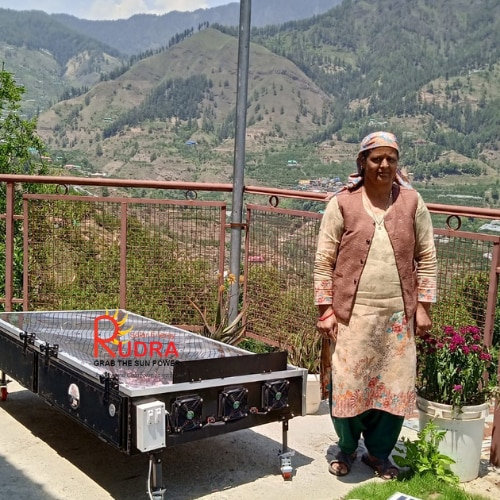
Why Meghalaya Needs Climate-Aware Solar Drying
Meghalaya receives substantial monsoon rainfall and is widely characterised by a humid hill environment. The state government describes Meghalaya as strongly influenced by the southwest monsoon and abundant rainfall.
These conditions matter during drying because the surrounding air already contains moisture.
A solar drying process works by encouraging moisture to leave the product and enter the surrounding drying air. Once the air becomes moisture-laden, it needs to move away from the product so further moisture removal can continue.
This makes airflow management particularly important in humid conditions.
A drying chamber may become warm, but temperature alone does not guarantee effective moisture reduction.
The process should instead be understood as:
solar heat + airflow + product loading + humidity management + moisture endpoint
Cloud cover, rainfall periods and high ambient humidity can slow drying performance. An enclosed solar drying system can reduce direct exposure of loaded material to rain, dust and insects compared with completely open drying, but drying performance still depends on weather and operating conditions.
Lakadong Turmeric: A Distinct Meghalaya Solar Drying Application
Lakadong turmeric is one of Meghalaya’s recognised high-value agricultural products. The state’s investment portal specifically identifies Lakadong turmeric among its important high-value crops, while the Agriculture Department lists turmeric as one of Meghalaya’s prominent spices.
Turmeric provides a useful example of why solar drying should be treated as one stage of a larger processing sequence.
Depending on the intended product and processing practice, turmeric may undergo preliminary handling before entering the drying stage.
The role of solar drying is specifically to reduce moisture from appropriately prepared turmeric material.
Operations such as washing, curing where required, polishing, grinding and packaging remain separate processes.
For prepared turmeric, useful drying considerations include:
product form
rhizome or slice size
initial moisture
loading depth
usable tray area
airflow
temperature
ambient humidity
required final moisture condition
A processor should not assume that maximum chamber temperature will automatically give the best result. Appropriate operating conditions depend on the material being dried.
Ginger Drying Requires Attention to Thickness and Product Form
Ginger is another prominent spice crop in Meghalaya. The Department of Agriculture identifies ginger among the state’s important spices and also maintains specific processing guidance for ginger products.
Fresh ginger is a dense rhizome, so the form in which it enters the dryer strongly affects moisture movement.
Whole rhizomes, thick pieces and thin slices do not behave identically.
Where prepared ginger is intended for dehydration, processors should consider:
piece or slice thickness
uniformity of preparation
tray distribution
loading depth
air movement
temperature
relative humidity
required drying endpoint
Thicker material creates a longer path for internal moisture to reach the product surface.
For this reason, preparation consistency can have a significant influence on batch behaviour.
A solar drying system does not automatically produce ginger powder. Grinding or milling remains a separate operation after appropriate drying and handling.
Solar Drying of Pineapple in Meghalaya
Pineapple is documented across Meghalaya’s tropical and subtropical horticultural zones and is also identified by the state as a high-value crop.
Fresh pineapple contains substantial moisture, creating a very different drying requirement from spices such as black pepper or chilli.
Where pineapple is intended for dehydration, preparation and tray utilisation become particularly important.
A processor should consider:
maturity and raw-material condition
prepared slice or piece dimensions
consistency between pieces
fresh input quantity
spacing between pieces
usable tray area
airflow between trays
ambient humidity
required final moisture
A high-moisture fruit should not simply be stacked deeply to maximise kilograms per tray.
Prepared pieces generally need adequate surface exposure so moving air can interact with the product and carry released moisture away.
For pineapple, this means practical drying capacity should be evaluated through both:
fresh batch weight + available drying surface
rather than kilogram capacity alone.
Jackfruit Creates Another Value-Addition Pathway
Jackfruit is another high-value crop identified in Meghalaya’s agricultural economy.
Jackfruit processing can create several different product forms, so the material entering the drying stage must first be clearly defined.
Prepared jackfruit pieces may have a different moisture content, thickness and tray requirement from pineapple or banana.
For suitable jackfruit drying applications, processors should evaluate:
product preparation
piece dimensions
fresh moisture
loading density
airflow
temperature
required dried-product condition
The drying stage should remain separate from cutting, seed removal, processing, milling or packaging operations where those are required.
Chilli and Black Pepper Need Different Loading Strategies
Meghalaya’s Agriculture Department identifies chilli and black pepper among important spice crops. Black pepper is prominent in lower-altitude areas, while chilli occurs across multiple horticultural zones.
Although both are spices, they should not automatically be dried using identical operating conditions.
Chilli can create a relatively loose product bed depending on the variety and loading method.
Black pepper berries create a denser particulate layer.
This difference affects how air moves through or around the loaded material.
For chilli and pepper drying, useful questions include:
How deep is the product layer?
Can drying air move through the batch?
Is the product spread evenly?
What is the incoming moisture condition?
What humidity conditions are expected?
What final moisture condition is required?
The answer should determine the operating approach rather than applying one universal spice-drying recipe.
Why Airflow Matters as Much as Temperature
One of the most important principles in solar drying is that heated air must also carry moisture away.
When a product releases water vapour, the surrounding air gradually becomes more humid.
If moisture-laden air remains trapped around the product, further moisture removal can slow.
This means a useful drying environment needs both thermal energy and air exchange.
Tray spacing and product arrangement influence that air movement.
A processor should therefore consider:
air inlet
airflow path
tray spacing
product thickness
loading depth
air outlet or exhaust
fan-assisted airflow where applicable
ambient humidity
For Meghalaya’s humid conditions, understanding this relationship is particularly valuable.
Tray Loading Should Change with the Commodity
A common mistake in agricultural drying is treating tray capacity only as kilograms.
Different commodities can occupy drying space very differently.
For example:
Pineapple requires substantial tray surface when prepared as slices or pieces.
Ginger may occupy less area by weight but creates a different moisture path through dense material.
Chilli can form a deeper loose layer.
Black pepper creates a denser grain-like bed.
Herbs and leafy products may occupy considerable tray volume at relatively low weight.
This is why useful capacity planning should consider:
weight + physical form + available tray area + layer depth + airflow
rather than only the maximum amount that can physically fit inside a chamber.
Solar Drying of Vegetables in Meghalaya
Meghalaya’s crop-distribution data includes vegetables, potato and sweet potato across several agro-climatic zones, with off-season vegetables particularly associated with higher elevations.
Suitable vegetables can create additional seasonal solar drying opportunities for farmers and processors.
However, vegetable drying requirements vary substantially.
Tomato has a high initial moisture level.
Potato and sweet potato require appropriate preparation before dehydration.
Leafy vegetables have low bulk density and can occupy large tray volumes.
For each commodity, processors should determine:
the intended dried product
appropriate preparation
piece thickness
initial moisture
tray loading
airflow
drying endpoint
post-drying handling
Calling all of these products simply “vegetables” is not enough to define the actual drying process.
Can One Solar Drying System Handle Several Meghalaya Crops?
A suitable system may potentially support multiple compatible commodities in separate batches.
For a Meghalaya FPO, SHG or processing enterprise, seasonal applications might include:
Lakadong turmeric
ginger
chilli
black pepper
pineapple
jackfruit
selected vegetables
herbs
other suitable horticultural produce
This can improve the usefulness of processing infrastructure across different harvest periods.
However, multi-product capability does not mean one operating setting for every commodity.
Whenever the product changes, the operator may need to reconsider:
preparation
tray loading
layer depth
temperature
airflow
drying duration
endpoint assessment
cleaning between batches
The process should follow the commodity.
Solar Drying Across Meghalaya’s Different Agro-Climatic Zones
Meghalaya’s Agriculture Department divides the state into tropical, subtropical and temperate horticultural zones, each with different crop combinations.
Lower-elevation areas include crops such as pineapple, banana, guava, arecanut, black pepper, turmeric and chilli.
Subtropical areas include pineapple, ginger, turmeric, cinnamon, chilli, potato, sweet potato and vegetables.
Higher zones include temperate fruits, potato, spices and off-season vegetables.
This geographic variation means solar drying practices should not be based simply on the state name.
A processor should consider the actual installation location because altitude, ambient temperature, cloud cover, humidity and solar availability can change from one area to another.
The same commodity may therefore behave differently under different local operating conditions.
What Happens During Cloudy or Rainy Periods?
Solar drying performance naturally changes when solar radiation decreases.
During cloudy periods, less thermal energy may be available.
During periods of high humidity, the surrounding air may also have less capacity to accept additional moisture from the product.
This can extend drying time.
For processors working with time-sensitive batches, this variation should be considered during production planning.
Depending on the drying system and processing requirement, an appropriately designed hybrid or backup arrangement may provide additional operating flexibility.
However, backup should not automatically be treated as necessary for every application.
The decision should depend on:
commodity
season
location
production schedule
daily quantity
acceptable drying window
How Should the Drying Endpoint Be Determined?
Drying should not automatically stop because a fixed number of hours has passed.
Drying duration can change according to:
initial moisture
product thickness
loading density
airflow
temperature
solar radiation
relative humidity
system configuration
The required endpoint should instead relate to the moisture condition needed for subsequent handling, storage or further processing.
Where appropriate, processors should use suitable moisture measurement, product specifications or validated processing procedures rather than relying only on appearance.
A product that feels dry on the surface may still contain additional internal moisture.
Solar Drying Is Only One Part of Post-Harvest Processing
Good drying results can be compromised by poor handling before or after the drying stage.
A broader workflow may include:
raw-material selection
sorting
washing where required
cutting or preparation
pretreatment where applicable
tray loading
solar drying
endpoint assessment
cooling
inspection
grinding or milling where applicable
packaging
storage
The exact workflow depends on the commodity.
For example, turmeric processing differs from pineapple processing, while black pepper requires a different post-harvest sequence from jackfruit.
This is why solar drying should be integrated into a commodity-specific processing system rather than treated as a stand-alone solution to every post-harvest problem.
Solar Drying for Farmers, FPOs, SHGs and Rural Enterprises
Meghalaya’s diverse horticultural production creates potential applications for several types of users.
These can include:
individual farmers
Farmer Producer Organisations
SHGs
agricultural cooperatives
spice processors
fruit processors
rural food enterprises
women-led processing groups
horticulture projects
food-processing MSMEs
research and training institutions
The appropriate scale of drying should match the normal quantity of raw material available.
A small group processing seasonal ginger or turmeric batches may have very different requirements from an aggregation centre handling produce from several villages.
A Practical Way to Plan Solar Drying in Meghalaya
Instead of beginning with equipment size, a processor can begin with eight questions:
What commodity will be dried?
What form will enter the drying stage?
What is its incoming moisture condition?
How much fresh material is available per batch or per day?
How much drying surface will it require?
How will air move through the loaded product?
What climate and humidity conditions are expected?
What final moisture condition is required?
These questions connect agricultural production with the actual drying process.
They are particularly relevant in Meghalaya, where high-value spices, fruits and vegetables can differ significantly in structure and moisture behaviour.
Building Better Solar Drying Practices for Meghalaya
Meghalaya has strong agricultural diversity, including Lakadong turmeric, ginger, chilli, black pepper, pineapple, jackfruit, potato and other horticultural crops identified by state agencies.
That diversity means there is no single universal drying recipe for the state.
A stronger approach is commodity-specific.
For Lakadong turmeric, understand the prepared material and drying stage within the broader processing workflow.
For ginger, focus on piece thickness and moisture movement.
For pineapple, prioritise preparation consistency and tray surface.
For chilli and black pepper, consider product-bed depth and airflow.
For vegetables and herbs, adjust loading according to structure and bulk density.
Across all these applications, effective solar drying depends on understanding how heat, airflow, humidity, product preparation and moisture interact.
Conclusion
Solar drying can support post-harvest moisture management for several suitable crops produced in Meghalaya, particularly where processors work with spices, fruits, vegetables and other horticultural materials.
The state’s diverse crop base and humid monsoon environment make commodity-specific processing especially important. Official Meghalaya sources identify Lakadong turmeric, ginger, black pepper, chilli, pineapple, jackfruit, vegetables and other horticultural products as significant parts of the state’s agricultural landscape.
The most practical approach to solar drying in Meghalaya is therefore:
Commodity → Preparation → Fresh Quantity → Tray Loading → Airflow → Temperature → Humidity → Moisture Endpoint → Post-Drying Handling
When these factors are understood together, solar drying can become a more organised and technically informed part of agricultural value addition for Meghalaya’s farmers, FPOs, SHGs and processing enterprises.