
Nagaland’s agricultural landscape gives solar drying a particularly strong application in spices, fruits and other high-value horticultural produce. The state’s official agriculture planning documents identify Naga King Chilli, ginger and turmeric among important commercial crops, while the Horticulture Department also highlights pineapple, banana, large cardamom and other horticultural produce. Naga King Chilli is additionally one of Nagaland’s recognised GI-tagged crops.
For this reason, solar drying in Nagaland should not be viewed simply as “putting produce in a solar dryer.” Each commodity has a different structure, initial moisture level, preparation method and desired final condition. Effective drying depends on how the material is prepared, how thickly it is loaded, how air moves around it and how moisture is allowed to leave the drying chamber.
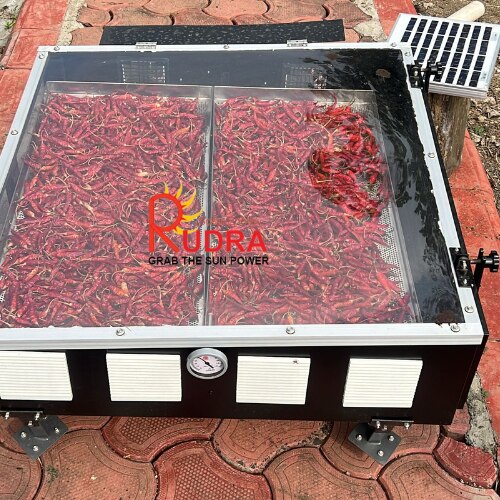
Naga King Chilli – A Distinctive Drying Application for Nagaland
Among all possible commodities, Naga King Chilli gives Nagaland one of its strongest state-specific solar drying applications.
The crop is closely associated with the state and remains an important spice in Nagaland’s agricultural system. Government planning documents specifically include Naga King Chilli among crops considered important for commercial development and agro-export potential.
Chilli drying is fundamentally a moisture-reduction process. Fresh chillies contain moisture that must be removed before the dried material is suitable for the intended downstream use.
A typical workflow may involve:
Harvesting
Sorting
Required Cleaning
Stalk Handling Where Required
Tray Loading
Solar-Assisted Drying
Moisture Assessment
Cooling
Grading
Further Processing or Storage
Grinding into chilli powder, packaging and final storage are separate operations and should not be confused with drying itself.
The drying behaviour of Naga King Chilli can vary according to fruit size, maturity, initial moisture, whether the chilli is dried whole or prepared differently, loading depth, airflow, temperature, relative humidity and solar availability.
Therefore, assigning one fixed drying time for every batch would be technically unreliable.
Why Chilli Loading Depth Matters
Fresh chillies should not simply be piled as deeply as possible onto the trays.
As moisture leaves the chilli, it enters the surrounding air. That moisture-bearing air needs to move away so that further evaporation can continue.
If product layers are excessively deep, parts of the batch may receive less effective airflow.
Solar drying of chilli therefore involves a balance between:
Available Solar Heat
Air Movement
Product Depth
Tray Surface Area
Chilli Size
Initial Moisture
Ambient Conditions
Required Drying Endpoint
The objective is not maximum heat. The objective is controlled moisture reduction across the batch.
Ginger Drying in Nagaland
Ginger is another major spice crop relevant to Nagaland’s agricultural value-addition potential. Official state planning documents include ginger among important commercial crops, while district-level food-processing plans also identify ginger as a major crop in several areas.
For ginger, preparation before drying can significantly influence the process.
Depending on the intended dried product, preparation may include:
Sorting
Washing
Cleaning
Peeling Where Required
Cutting
Slicing
Tray Loading
These steps are separate from the actual drying stage.
Prepared ginger with greater exposed surface area generally behaves differently from large or thick pieces because moisture has a shorter path to travel to the surface.
This means that when planning solar drying of ginger in Nagaland, processors should define the exact form entering the drying chamber rather than considering only total kilograms.
Ginger Slice Thickness and Drying Uniformity
Slice thickness is one of the practical variables that can influence ginger drying.
If one batch contains a mixture of very thick and very thin pieces, the material may not approach the drying endpoint uniformly.
Commercial or organised processing can therefore benefit from more consistent preparation before tray loading.
Relevant variables include:
Ginger Variety
Initial Moisture
Piece Size
Slice Thickness
Tray Loading
Airflow
Solar Radiation
Relative Humidity
Target Moisture
The same principle applies to many agricultural materials: preparation before drying directly affects what happens inside the drying chamber.
Solar Drying of Turmeric in Nagaland
Turmeric is also identified among Nagaland’s important commercial and organic-programme crops.
One of the most important technical distinctions for turmeric is that drying should not be confused with curing or boiling.
Depending on the turmeric-processing method, harvested rhizomes may first undergo separate preparation and curing operations before they reach the drying stage.
An illustrative processing flow can be:
Harvesting
Cleaning
Required Curing / Boiling
Cooling
Preparation
Solar Drying
Moisture Assessment
Polishing
Grinding Where Required
Packaging
A solar drying system is responsible for the moisture-removal stage only.
This distinction matters because good solar drying content should accurately explain the role of the process rather than suggesting that one piece of equipment performs every stage of turmeric processing.
Turmeric Fingers and Prepared Pieces Behave Differently
The physical form of turmeric influences how drying progresses.
A thick turmeric finger presents a different moisture-transfer path from a thinner prepared piece.
Processors should therefore consider:
Product Form
Material Thickness
Initial Moisture
Tray Arrangement
Airflow
Drying Temperature
Ambient Humidity
Required Final Condition
Solar drying should be adapted to the actual turmeric material rather than applying one universal time-and-temperature combination.
Research literature on solar drying of ginger and turmeric likewise treats drying behaviour as dependent on process conditions and material characteristics rather than one fixed universal schedule.
Pineapple and Fruit Drying Opportunities
Nagaland also has a significant horticultural base that includes pineapple and other fruits. Official horticulture information highlights pineapple among the state’s prominent crops, while district-level processing documents also list pineapple alongside passion fruit, banana and other produce.
Solar drying can be evaluated where dehydration is part of the intended pineapple-processing workflow.
Fresh pineapple typically requires preparation before drying, which may include:
Sorting
Washing
Peeling
Core Removal Where Required
Slicing or Cutting
Tray Arrangement
These operations should be completed separately.
Inside the drying system, prepared pineapple pieces undergo moisture reduction.
Why Fruit Drying Needs More Tray Area
Fresh fruits can contain substantial moisture and may require shallow, well-distributed loading.
A processor handling pineapple should therefore consider more than fresh batch weight.
Useful planning variables include:
Fresh Fruit Quantity
Prepared Slice Size
Slice Thickness
Usable Tray Area
Number of Trays
Layer Thickness
Airflow
Expected Number of Batches
Required Final Moisture
Two systems with the same nominal kilogram capacity may perform differently if their usable drying area and airflow arrangements are different.
This is why tray area and loading pattern are valuable concepts in solar drying.
Large Cardamom and Other Spice Applications
Nagaland’s horticultural sector also includes large cardamom, along with other spice and horticultural crops.
Where moisture reduction forms part of the post-harvest process, solar drying may be evaluated for suitable spice materials.
However, a multi-spice application should not be interpreted as one universal operating method.
Naga King Chilli
Ginger
Turmeric
Large Cardamom
and other spices differ in structure and processing requirements.
Each change in commodity may require changes in:
Preparation
Loading Depth
Tray Arrangement
Airflow
Temperature
Drying Duration
Endpoint Assessment
This is a central principle of application-based solar drying.
Solar Drying for Multi-Commodity Farmer Groups
Nagaland’s agriculture includes many crops grown across relatively small and diverse production areas.
For FPOs, SHGs, farmer groups and community processing centres, it may therefore be practical to use the same drying infrastructure for different suitable commodities in separate batches.
For example, seasonal processing might involve:
Naga King Chilli
Ginger
Turmeric
Pineapple
Selected Fruits
Large Cardamom
Other Suitable Spices
Compatible Botanical Materials
But multi-commodity capability should not mean mixing unrelated crops in the same batch or using identical settings for every product.
A processor should define a separate operating approach for each commodity.
The Importance of Humidity in Solar Drying
Solar drying depends not only on temperature but also on the condition of the surrounding air.
As agricultural material loses moisture, that moisture enters the drying air.
When ambient air already contains substantial moisture, the drying process may behave differently from a dry-weather condition.
This makes relative humidity an important parameter alongside:
Temperature
Solar Radiation
Airflow
Initial Product Moisture
Loading Depth
Product Thickness
Final Moisture Requirement
Solar drying therefore should not be described as weather-independent.
An enclosed solar drying system can create a more organised drying environment, but prevailing environmental conditions still influence performance.
Solar Drying Is Different from Open-Sun Drying
Traditional open-sun drying places produce directly in an outdoor environment.
Solar drying can instead place prepared material inside an enclosed or protected drying arrangement where solar energy is used to support moisture removal.
This can reduce direct exposure of the loaded product to uncontrolled outdoor contact such as dust, insects and birds.
The important distinction is process organisation.
Material can be:
Sorted Before Loading
Placed on Defined Drying Surfaces
Arranged in Controlled Layers
Inspected During Drying
Handled Batch by Batch
Removed at the Required Endpoint
These practices can make drying more systematic than simply spreading produce outdoors.
Airflow Is as Important as Solar Heating
Solar heat alone does not complete the drying process.
Moisture first needs to move from inside the product toward its surface.
It then evaporates into the surrounding air.
That moist air must move away from the product so that further drying can continue.
The process therefore depends on the interaction of:
Heat Transfer
Mass Transfer
Air Movement
Product Surface Area
Material Thickness
Relative Humidity
Loading Arrangement
For processors, understanding this relationship is more useful than simply asking for the highest possible drying temperature.
The Drying Endpoint Should Be Defined
A product may look dry on the outside before it has reached the desired moisture level throughout the material.
Commercial or organised processing should therefore avoid relying only on appearance.
The required drying endpoint depends on:
Commodity
Final Product
Storage Method
Further Processing
Buyer Requirements
Applicable Processing Standards
The appropriate endpoint for chilli may differ from ginger, turmeric or pineapple.
Solar drying should therefore be treated as a controlled processing operation rather than simply “drying until it looks dry.”
Post-Drying Handling Matters Too
The condition of the product after drying can also influence the final result.
Material may require appropriate cooling before packaging or storage.
A practical post-drying sequence can include:
Drying Endpoint Assessment
Removal from Trays
Cooling
Sorting
Grading
Required Further Processing
Packaging
Storage
If dried material is exposed again to humid conditions, moisture can potentially be reabsorbed.
This means good solar drying practice should consider both drying and post-drying handling.
Solar Drying and Local Value Addition in Nagaland
The strongest opportunity for solar drying in Nagaland is not simply replacing one drying method with another.
It is using drying appropriately within a broader local processing chain.
Instead of viewing Naga King Chilli, ginger, turmeric or pineapple only as freshly harvested commodities, processors can evaluate dried forms where there is a genuine market and technically suitable application.
However, drying alone does not guarantee profitability or market access.
A value-addition project should also consider:
Product Demand
Quality Specifications
Processing Cost
Packaging
Food Safety
Storage
Transport
Buyer Requirements
Market Linkages
Solar drying is one processing stage within that broader system.
A Nagaland-Specific Approach to Solar Drying
Nagaland should not receive the same generic solar drying content used for every other Indian state.
Its strongest applications arise from its own crop profile.
Naga King Chilli brings a distinctive high-value spice application.
Ginger and turmeric require commodity-specific preparation and drying practices.
Pineapple creates a fruit-processing opportunity with a very different moisture and tray-loading profile.
Large cardamom and other suitable horticultural crops expand the range of potential post-harvest applications.
For farmers, FPOs, SHGs, agricultural cooperatives and food-processing enterprises, the correct approach is to begin with the commodity and understand its moisture-removal behaviour.
That means asking:
What exactly is being dried?
In what form?
At what quantity?
With what tray loading?
Under what climatic conditions?
To what final moisture level?
And for what end use?
When these questions guide the process, solar drying in Nagaland becomes more than a generic renewable-energy concept. It becomes a crop-specific post-harvest tool that can support organised processing of Naga King Chilli, ginger, turmeric, pineapple and other suitable agricultural materials while respecting the technical differences between each commodity.