


Sikkim’s High-Value Crops Need Commodity-Specific Solar Drying
Sikkim has a distinctive horticultural and spice economy shaped by its Himalayan terrain and humid climate. The state’s official horticulture profile includes large cardamom, ginger, turmeric, cherry pepper, Sikkim mandarin, kiwi, banana, vegetables, mushrooms and medicinal plants. Among these, large cardamom has particularly strong relevance: the Sikkim Agriculture Department identifies it as the state’s main cash crop.
This crop diversity creates several opportunities for solar drying in Sikkim, but each commodity requires a different moisture-removal approach. Large cardamom capsules, ginger rhizomes, turmeric, chilli and sliced fruits differ in initial moisture, physical structure, loading density, preparation and required final condition.
Effective solar drying therefore depends on the relationship between commodity type, preparation, drying area, loading depth, airflow, temperature, relative humidity, available solar radiation and required final moisture.
Sikkim’s climate makes this especially important. Official agricultural guidance describes large-cardamom-growing conditions as humid and often cloudy or foggy during the monsoon, with annual rainfall of roughly 3,000–3,500 mm in its traditional growing environment.
Solar drying in such conditions should therefore be treated as an organised heat-and-moisture-management process, not simply as exposure to higher temperature.
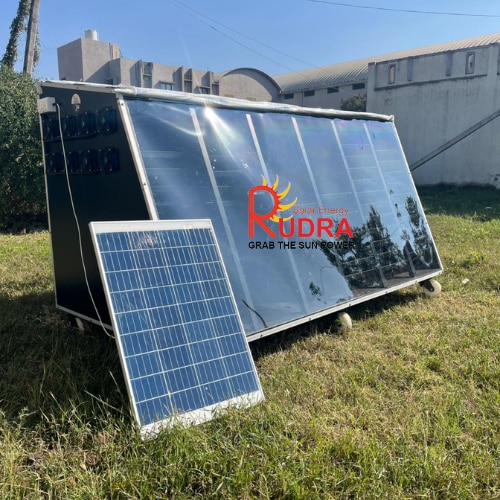
Large Cardamom Gives Sikkim a Unique Solar Drying Application
Large cardamom is the strongest state-specific solar drying application for Sikkim.
Fresh large-cardamom capsules contain substantial moisture and traditionally require curing/drying before suitable long-term storage and marketing. Sikkim’s Agriculture Department notes that fresh capsules generally contain around 80–85% moisture on a wet basis and require major moisture reduction during drying.
Solar drying is also not merely theoretical for this crop. Solar-dryer research has been carried out specifically at Ranipool, Sikkim, and newer research published in 2025–26 has evaluated a solar-biomass hybrid dryer specifically for large cardamom under Sikkim conditions.
However, results from one research dryer should not be converted into a universal drying time, temperature or performance claim for every system.
The correct drying approach depends on the actual cardamom batch and local operating conditions.
Why is solar drying important for large cardamom in Sikkim?
Large cardamom requires significant moisture removal after harvest before appropriate storage or further marketing. Traditional curing practices may involve direct combustion systems, while solar-assisted drying provides another pathway for supplying drying heat and moving moisture away from the capsules. Sikkim’s own Agriculture Department discusses the limitations of traditional smoke-based curing systems and the need for improved cardamom drying.
For solar drying, important variables include:
Initial capsule moisture
Capsule maturity and condition
Loading depth
Airflow
Drying temperature
Relative humidity
Available solar energy
Required final moisture
These factors should be assessed together rather than controlling the process by temperature alone.
Can large cardamom be dried using solar energy in Sikkim?
Yes. Large cardamom has been directly studied using solar drying technology in Sikkim.
Research at the College of Agricultural Engineering and Post Harvest Technology in Ranipool evaluated forced-convection solar drying of large cardamom, and a more recent study evaluated a solar-biomass hybrid dryer for the same crop in Sikkim.
These studies establish large cardamom as a technically relevant solar-drying application.
Actual commercial drying performance, however, will depend on dryer design, loading, weather, airflow and the condition of the incoming crop.
How does Sikkim’s humidity affect solar drying?
Relative humidity influences how readily drying air can accept additional moisture from a product.
This matters in Sikkim because large-cardamom-growing environments can experience substantial rainfall, cloud and fog.
During a drying process, three factors work together:
Heat supplies energy for moisture movement.
Airflow removes moisture-bearing air from around the product.
Loading depth affects how easily that air can reach different parts of the batch.
A warm drying chamber with insufficient airflow or excessive loading may still remove moisture slowly.
What crops can be solar dried in Sikkim?
Depending on the intended product and required processing method, solar drying may be relevant to suitable materials such as:
Large Cardamom
Ginger
Turmeric
Cherry Pepper / Dalle-type Chilli
Sikkim Mandarin
Kiwi
Selected Vegetables
Mushrooms
Selected Medicinal Plants
Other Suitable Horticultural Produce
These crop groups are part of Sikkim’s official horticultural and spice profile.
The same drying settings should not automatically be applied across these commodities.
How can ginger be solar dried in Sikkim?
Ginger requires a different process from large cardamom because the harvested material is a dense rhizome.
Depending on the intended dried product, separate preparation may involve washing, cleaning, peeling where required, cutting or slicing.
These operations occur before drying.
Once properly prepared, the drying stage is influenced by:
Initial moisture
Piece or slice thickness
Loading depth
Drying surface area
Airflow
Temperature
Relative humidity
Required final condition
The Sikkim Government includes ginger among the state’s important spice crops.
Consistent slice thickness can also make a batch easier to manage than a mixture of very thin and very thick pieces.
Can turmeric be solar dried in Sikkim?
Yes, where solar drying is compatible with the intended turmeric-processing method.
However, turmeric drying and turmeric curing are not the same operation.
Depending on the processing method, harvested turmeric may undergo washing, curing or boiling and other preparation before the drying stage.
Solar drying then performs moisture reduction from the appropriately prepared material.
Turmeric is officially included among Sikkim’s important spice crops alongside large cardamom, ginger and cherry pepper.
Can cherry pepper or chilli be solar dried in Sikkim?
Where dried chilli is the intended output, suitable harvested chilli can be processed using solar drying.
Important factors include:
Fruit size
Whole or prepared form
Initial moisture
Maturity
Tray loading
Airflow
Ambient humidity
Required final moisture
Sikkim’s official horticultural programme includes cherry pepper among the state’s spice crops.
Chilli should not automatically be dried using the same settings as cardamom, ginger or turmeric.
Can Sikkim mandarin and kiwi be solar dried?
Suitable prepared fruit can be solar dried where dehydration is part of the intended final product.
Sikkim’s official horticultural profile specifically includes Sikkim mandarin and kiwi, along with other fruits such as pear, papaya and banana.
Fruit usually requires separate preparation such as:
Sorting
Washing
Peeling where required
Deseeding
Segmenting or slicing
The solar drying stage starts after suitable preparation.
Because fruit pieces can contain high levels of moisture, slice thickness and usable drying area can become particularly important.
Why does tray loading matter in solar drying?
Kilogram capacity alone does not describe how effectively a crop can be dried.
The same fresh weight of large cardamom, ginger slices, chilli and kiwi slices may require very different amounts of physical drying area.
Loading should therefore consider:
Fresh material weight
Bulk volume
Available drying surface
Layer thickness
Airflow path
Number of batches
Required daily throughput
Excessive layer depth can make it more difficult for drying air to interact with material deeper within the batch.
Is there one ideal solar drying temperature for all Sikkim crops?
No.
Large cardamom, ginger, turmeric, chilli, fruit and medicinal plant materials differ in structure and processing requirements.
The appropriate drying condition depends on:
Commodity
Product form
Initial moisture
Thickness
Temperature sensitivity
Airflow
Relative humidity
Required final moisture
Intended end use
Individual research studies may report specific temperatures for a particular dryer and experiment, but those values should not automatically be treated as universal settings for every solar drying system. Recent Sikkim research, for example, evaluated large cardamom under a defined experimental solar-biomass hybrid configuration—not all crops or all dryers.
How long does solar drying take in Sikkim?
There is no universal solar drying time for Sikkim.
Drying duration changes according to:
Initial moisture
Target moisture
Commodity structure
Piece thickness
Batch loading
Solar radiation
Ambient temperature
Relative humidity
Airflow
Dryer design
Even two batches of the same crop may not require identical drying time when weather or initial moisture changes.
For this reason, moisture progress and the required final condition are more useful process indicators than promising one fixed number of hours.
Is hybrid solar drying useful in Sikkim?
Hybrid drying can be relevant where a processing operation requires additional heat support during periods of insufficient solar availability.
This has particular technical relevance in Sikkim because solar-biomass hybrid drying has been specifically researched for large cardamom in the state.
However, the need for hybrid support depends on the application.
Factors include:
Commodity
Season
Local weather
Required processing schedule
Daily throughput
Available energy source
Required final moisture
A solar-only or hybrid approach should therefore be selected according to the actual drying requirement.
What is the difference between open-sun drying and enclosed solar drying?
Open-sun drying places material directly in the outdoor environment.
An enclosed solar drying system uses a defined drying space where suitable product can be arranged and solar-heated air used for moisture removal.
This creates more control over:
Product loading
Drying surface
Airflow
Batch organisation
Inspection
Cleaning between commodities
Protection from direct outdoor exposure
However, an enclosed solar dryer is not completely weather-independent. Solar radiation, temperature and ambient humidity continue to influence performance.
How should solar drying be managed during cloudy weather in Sikkim?
Cloud cover can reduce available solar energy, while high relative humidity can reduce the moisture-removal potential of the drying air.
Operators should therefore pay attention to:
Solar availability
Chamber temperature
Relative humidity
Airflow
Product moisture
Loading depth
Drying progress
Sikkim’s large-cardamom production areas are officially described as frequently cloudy and foggy during the monsoon, making this particularly relevant to local post-harvest drying.
The response should be based on drying conditions and moisture progress rather than increasing temperature without considering airflow and humidity.
Why is post-drying storage important in Sikkim?
Drying is only one stage of post-harvest moisture management.
After drying, material may require:
Cooling
Moisture verification
Sorting
Grading
Packaging
Storage
Protection from re-wetting
This can be especially important in humid conditions because dried material exposed again to moist air may interact with surrounding humidity.
A complete drying plan therefore includes both moisture removal and suitable post-drying handling.
What makes solar drying in Sikkim different from other regions?
Sikkim combines three factors that create a particularly distinctive solar-drying context:
High-value Himalayan crops such as large cardamom, ginger and turmeric.
Humid and cloudy hill conditions that make airflow and moisture management important.
Diverse horticultural produce ranging from spices to mandarin, kiwi, vegetables, mushrooms and medicinal plants.
Because of this diversity, the strongest solar drying approach for Sikkim is commodity-specific rather than one-size-fits-all.
A good drying process begins by identifying the product, incoming moisture, preparation, drying surface, loading depth, airflow requirement, weather conditions and required final moisture.
