
Tripura’s Pineapple and Jackfruit Economy Creates a Strong Solar Drying Use Case
Tripura has a distinctive horticultural profile led by pineapple, along with jackfruit, ginger, chilli, vegetables and other farm produce. ICAR identifies Tripura as one of the major pineapple-producing states of Northeast India, while the Government of Tripura has also implemented a dedicated Pineapple and Jackfruit Mission, showing the importance of these two crops within the state’s horticultural value chain.
This makes solar drying in Tripura especially relevant for post-harvest applications where farmers or processors want to convert suitable fresh produce into dried ingredients or products.
However, pineapple, jackfruit, ginger and chilli cannot be treated as one common drying material.
They differ in:
Initial moisture
Sugar and solid content
Physical structure
Piece thickness
Preparation method
Loading density
Usable drying area
Airflow requirement
Required final moisture
Solar drying should therefore be designed around the specific commodity and moisture-removal requirement, not around one universal drying time or temperature.
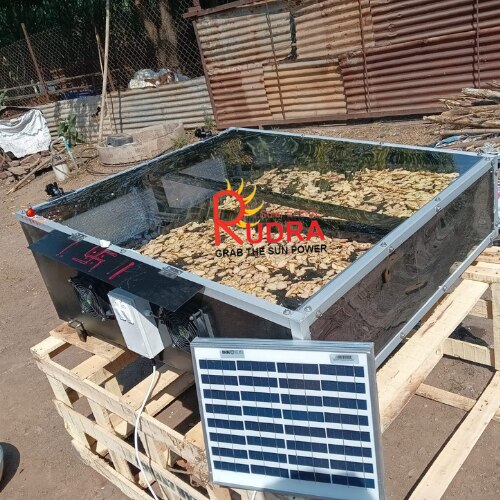
Queen Pineapple Gives Tripura a Distinctive Solar Drying Identity
Pineapple is particularly important to Tripura. ICAR notes that Tripura is one of the largest pineapple-producing states in the northeastern region, making pineapple a strong state-specific post-harvest application rather than a generic fruit example.
Where dried pineapple is the intended product, the fruit first requires suitable preparation before entering the drying stage.
Depending on the product, this may include:
Sorting
Washing
Peeling
Eye removal
Core removal where required
Slicing
Piece-size standardisation
These are separate preparation operations.
Solar drying then performs the moisture-reduction stage from the prepared pineapple material.
Because fresh pineapple is a high-moisture fruit, tray surface, slice thickness and airflow can become particularly important during drying.
What crops can be solar dried in Tripura?
Solar drying may be relevant to suitable Tripura produce such as:
Queen Pineapple
Jackfruit
Ginger
Chilli
Selected Vegetables
Selected Fruits
Mushrooms
Selected Tuber Crops
Other Appropriate Horticultural Produce
ICAR documentation for Tripura records pineapple as a major crop and also documents farming systems involving vegetables, mushrooms, ginger, chilli and tuber crops.
The exact drying procedure should be changed whenever the commodity changes.
Can Queen Pineapple be solar dried in Tripura?
Yes. Appropriately prepared pineapple can be solar dried where dehydration forms part of the intended processing method.
The main drying considerations include:
Fruit maturity
Initial moisture
Slice thickness
Piece dimensions
Tray surface area
Loading depth
Airflow
Relative humidity
Required final moisture
Thin slices and thick chunks should not automatically be expected to reach the same drying endpoint at the same time.
For this reason, preparation consistency is an important part of pineapple solar drying.
Why is slice thickness important when solar drying pineapple?
Moisture inside a fruit piece has to move toward the surface before it can leave the product.
A thicker pineapple piece generally creates a longer moisture-transfer path than a thinner slice.
If one tray contains highly inconsistent piece thicknesses, parts of the batch may progress differently.
A practical pineapple-drying process should therefore aim for reasonably consistent:
Slice thickness
Piece size
Tray loading
Layer depth
This does not mean that one exact thickness is universal for every product. The correct preparation depends on the desired dried pineapple format.
Can jackfruit be solar dried in Tripura?
Yes, suitable prepared jackfruit material can be evaluated for solar drying where a dried product is intended.
Tripura’s decision to implement a Pineapple and Jackfruit Mission confirms jackfruit as an important state value-chain crop.
Depending on the intended product, separate preparation can include:
Fruit opening
Bulb separation
Seed removal
Cutting or slicing
Batch preparation
These operations are separate from the drying stage.
Solar drying then removes moisture from the appropriately prepared jackfruit material.
Can jackfruit seeds also be dried?
Where jackfruit seeds are intended for suitable dried or further-processed applications, moisture reduction can form part of the processing chain.
Seed material should not automatically be handled like jackfruit flesh because the two differ greatly in:
Density
Structure
Initial moisture
Loading behaviour
Required downstream processing
ICAR also documents value-added technologies using jackfruit seed powder, illustrating that jackfruit seeds can form a separate processing raw material.
The drying method should therefore be designed around the seed application itself.
How can ginger be solar dried in Tripura?
Ginger is another relevant Tripura processing application. ICAR documents ginger cultivation and post-harvest activity within farming systems in the region.
Depending on the desired product, ginger preparation may involve:
Sorting
Cleaning
Washing
Peeling where required
Cutting
Slicing
Drying takes place after suitable preparation.
For ginger, important variables include:
Rhizome or slice thickness
Initial moisture
Loading depth
Tray area
Airflow
Temperature
Relative humidity
Required final condition
Dense whole rhizomes should not automatically be expected to dry like thin prepared slices.
Can chilli be solar dried in Tripura?
Yes, where dried chilli is the intended output.
ICAR records chilli among crops grown in Tripura farming systems.
Useful drying considerations include:
Chilli variety
Maturity
Whole or prepared form
Fruit size
Initial moisture
Tray loading
Airflow
Required final moisture
Chilli should not automatically use the same operating conditions as pineapple or ginger simply because all three can be processed using solar-assisted drying.
Why is airflow important in solar drying?
Solar heat provides energy for moisture removal, but heat alone does not complete the process.
As moisture leaves the product, it enters the surrounding air.
That moisture-bearing air needs to move away so further moisture can continue leaving the material.
Effective drying therefore depends on the interaction between:
Heat
Airflow
Initial moisture
Product structure
Loading depth
Tray spacing
Ambient conditions
Required final moisture
Increasing temperature without managing airflow or excessive loading does not automatically result in better drying.
Why does tray loading matter for Tripura’s fruits and spices?
Different crops can require very different amounts of drying surface even when their fresh weights are similar.
For example:
50 kg pineapple slices
50 kg ginger
50 kg chilli
50 kg jackfruit
may not occupy the same tray area or require the same loading depth.
Solar drying capacity should therefore be considered in terms of:
Fresh Weight + Material Volume + Usable Drying Area + Loading Depth + Required Throughput
rather than kilograms alone.
This is particularly relevant for farmer groups or processing centres using one system for several seasonal products.
Can one solar drying system process pineapple, jackfruit and ginger?
A suitably configured system may be able to handle multiple compatible commodities in separate batches.
However, multi-commodity use does not mean one fixed operating setting.
When switching from pineapple to ginger or jackfruit, processors may need to reconsider:
Preparation
Piece size
Tray loading
Layer depth
Airflow
Temperature
Drying duration
Required final moisture
Cleaning between batches
Each product should retain its own drying procedure.
Is there one ideal solar drying temperature for Tripura crops?
No.
There is no single ideal temperature for pineapple, jackfruit, ginger, chilli and other horticultural produce.
The appropriate operating condition depends on:
Commodity
Product form
Initial moisture
Thickness
Temperature sensitivity
Airflow
Ambient conditions
Required final moisture
Intended end use
The objective should be controlled moisture reduction, not simply reaching the highest possible air temperature.
How long does solar drying take in Tripura?
There is no universal drying time.
Drying duration can vary with:
Commodity
Initial moisture
Target moisture
Slice or piece thickness
Loading depth
Airflow
Available solar energy
Ambient temperature
Relative humidity
Drying-system design
Two batches of the same crop can also behave differently if incoming moisture or weather changes.
For this reason, drying progress should be judged using the required final condition rather than relying only on a fixed number of hours.
How do weather conditions affect solar drying in Tripura?
Tripura’s agriculture operates across hilly and valley landscapes, and local weather conditions influence agricultural operations. ICAR describes the state as having warm summers and varied agro-climatic conditions.
For solar drying, changing weather can influence:
Available solar energy
Drying-air temperature
Ambient humidity
Rate of moisture removal
Processing duration
A solar drying system should therefore be operated according to actual drying conditions rather than assuming that every day will provide identical performance.
Is hybrid solar drying useful in Tripura?
Hybrid drying can be useful where a processing operation requires additional energy support during periods of inadequate solar availability.
Whether hybrid support is appropriate depends on:
Commodity
Season
Daily processing requirement
Available solar energy
Required production schedule
Desired turnaround
Available backup energy source
Hybrid drying should not be treated as compulsory for every application.
It is an operating option to be evaluated when the processing requirement justifies it.
What is the difference between open-sun drying and enclosed solar drying?
Open-sun drying places agricultural produce directly in the outdoor environment.
Enclosed solar drying places suitable prepared material inside a defined drying space where solar-assisted heating and organised airflow can support moisture removal.
An enclosed process can provide greater control over:
Tray organisation
Loading depth
Batch identity
Airflow
Product handling
Inspection
Cleaning between batches
It can also reduce direct exposure of the loaded material to dust, insects, birds and uncontrolled outdoor contact.
However, enclosed solar drying should still not be described as completely independent of local weather conditions.
Why is post-drying storage important?
Drying is not the final step in moisture management.
After drying, suitable produce may require:
Cooling
Moisture assessment
Sorting
Grading
Packaging
Storage
Protection from re-wetting
If dried material is exposed again to unsuitable environmental conditions, it can interact with moisture in the surrounding air.
Post-drying handling should therefore be planned together with the drying stage.
Why is solar drying particularly relevant to Tripura’s horticultural value addition?
Tripura already has strong institutional emphasis on pineapple and jackfruit value chains through its dedicated mission, while ICAR identifies pineapple as one of the state’s major horticultural crops.
This creates a practical post-harvest context for exploring drying applications involving:
Pineapple
Jackfruit
Spices
Vegetables
Other suitable horticultural materials
The important principle is to treat solar drying as a commodity-specific post-harvest process, not simply as a generic machine application.
What makes solar drying in Tripura different from other states?
Tripura’s strongest solar-drying identity can be built around its own crop mix rather than copying another Northeast state.
For Tripura, the most distinctive relationship is:
Tripura → Queen Pineapple → Jackfruit → Ginger/Chilli → Horticultural Processing → Moisture Management
This differs from:
Sikkim → Large Cardamom
Nagaland → Naga King Chilli
Arunachal Pradesh → Kiwi / Large Cardamom
That state-specific crop identity is important for technically useful and locally relevant solar-drying content.